banner
BYTE SHIFT

HELLO WORLD
Section 2
SIGNAL SPEEDS
Han Erim
30 November 2015
In
the first part of the article, we examined how Byte Shift occurs on
electromagnetic signals during wireless communication with moving
frames
(reference systems) due to the Doppler Shift. In this second part, I
will explain the signal speed towards a moving frame by utilizing the
Byte Shift phenomenon.
To avoid repetition, I did not explain what was covered in the
first part of the article. Therefore, if you have not read the first
part yet, I kindly ask you to start with that.
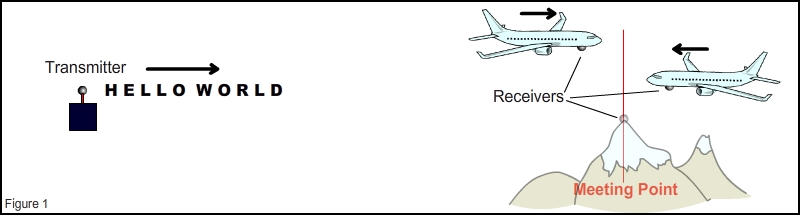
Our scenario here consists of two airplanes moving in opposite
directions, a mountain, and a signal transmitter (Figure
1). As the airplanes approach the "Meeting Point", the "HELLO
WORLD" message is transmitted. We will analyze the moment at the
"Meeting Point", where the signal receivers in the mountain and on both
airplanes are equidistant from the transmitter.
Since we are calculating the signal speed, let’s construct the
scenario as follows: At the moment the meeting point is reached, the
signal receiver on the mountain is receiving the 44th Bit of the "HELLO
WORLD" message. Since the "Hello World" message consists of 88 Bits,
the
44th Bit corresponds exactly to the midpoint of the message. Now let's
perform the necessary Byte Shift calculations and find out which Bit of
the message the airplanes are receiving at the "Meeting Point".
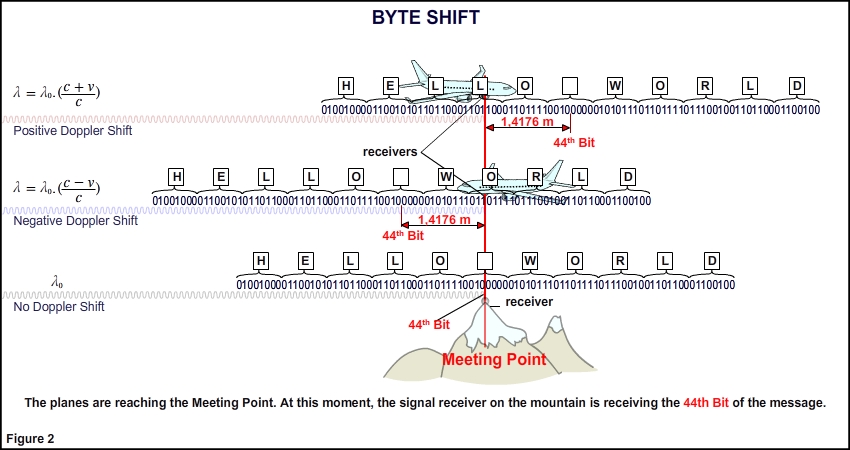
In Figure 2 above, we see that the signals come
from the same transmitter, but the transmitter is not included in the
figure because it is at a great distance. The figure was prepared based
on the Excel table below. You can download the Excel file for detailed
analysis here.
As shown in the figure, due to Byte Shift, the receiver on the
mountain receives the Space character, while the
receiver on the receding airplane receives the L
character, and the receiver on the approaching airplane receives the
O character. However, since we are discussing signal
speeds, we should speak in terms of Bits rather than Bytes.
As seen in the calculations, the signal chain carrying the "HELLO
WORLD" message is shifted by +1.4176 meters for the receding airplane
and -1.4176 meters for the approaching airplane. Based on these
distances, the positions of the 44th Bit are marked
in
the figure. We will use the positions of the 44th Bit
in the next stage to find the signal speeds.
As a note; in the figure, it appears as though the signals continue
traveling after reaching their destinations. In reality, this would not
happen — the journey of a signal ends the moment it reaches its target.
The figure is illustrated in this way because this representation was
preferred for the required calculations.
| BYTE SHIFT
CALCULATION |
| Airplane Speeds (MACH) |
2.5 |
| Signal Frequency (GHz) |
3.18 |
| Transmitter Distance (kilometers) |
500 |
| Speed of Light (c) (meters/second) |
299792458 |
| Airplane Speeds (v) (MACH × 340 m/s) |
850 |
| Transmitter Distance (millimeters) |
500000000 |
| Doppler Effect on the Signal |
| It is assumed that the transmitter is stationary. All λ
values are in millimeters. |
|
| Wavelength (λ₀) - For the mountain |
94.27435786 |
| Wavelength (λ₁) - For the receding airplane |
94.27462516 |
| Wavelength (λ₂) - For the approaching airplane |
94.27409057 |
| Meeting Point Calculations |
| Number of Bits for the mountain (n₀ = distance / λ₀) |
5303669.114 |
| Number of Bits for the receding airplane (n₁ = distance / λ₁) |
5303654.076 |
| Number of Bits for the approaching airplane (n₂ = distance /
λ₂) |
5303684.151 |
| Bit shift between mountain and receding airplane (n₀ - n₁) |
15.0374 |
| Bit shift between mountain and approaching airplane (n₀ - n₂) |
-15.0375 |
| Bit shift between receding and approaching airplanes (n₂ - n₁) |
30.0749 |
Note: The values used here are for calculation
purposes. In real-world applications, small variations may occur.
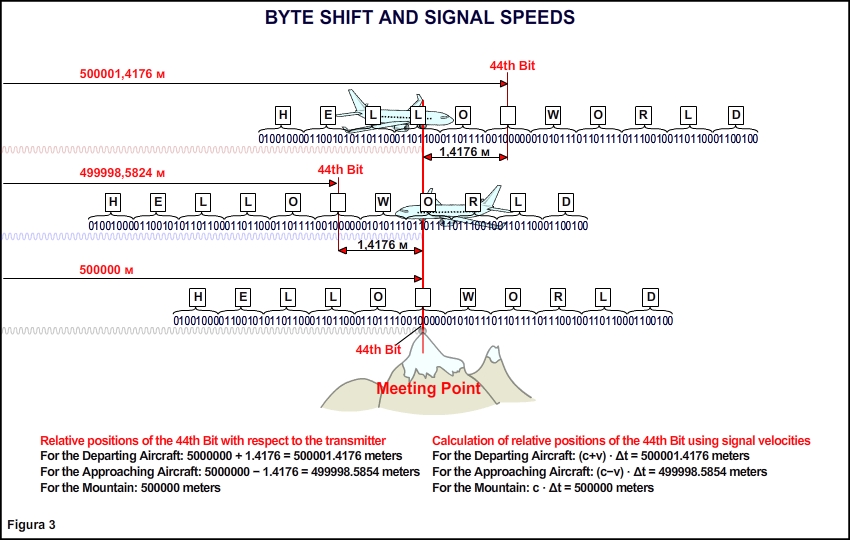
Calculation of Signal Speeds
Figure 3 was prepared based on the values in the Excel table. Since
we know the positions of the 44th Bit for all three frames, let us
write down their distances from the signal transmitter.
Distances of the 44th Bit from the signal transmitter:
For the receding airplane: 500000 + 1.4176 = 500001.4176 meters
For the approaching airplane: 500000 - 1.4176 = 499998.5824 meters
For the mountain: 500000 meters
Arrival time of the signal from the transmitter to the
mountain receiver:
Δt = Distance / Speed of Light = 500000 / 299792458 ≈ 0.00166782
seconds
During this time:
- The signal to the receding airplane travels 500001.4176 meters,
- The signal to the approaching airplane travels 499998.5824 meters.
With this information:
For the receding airplane: (c + v) × Δt = (299792458 + 850) ×
0.00166782 = 500001.4176 meters
For the approaching airplane: (c - v) × Δt = (299792458 - 850) ×
0.00166782 = 499998.5824 meters
As a result:
- Speed of the signal to the mountain = c = 299792458 m/s
- Speed of the signal to the receding airplane = c + v = 299793308
m/s
- Speed of the signal to the approaching airplane = c - v =
299791608 m/s
(c+v)(c-v) Mathematics for Electromagnetic Theory
Without delving into theoretical explanations, I have shown that the
(c+v)(c-v) mathematics is valid for Electromagnetic Theory based on
Doppler shift equations.
It is important to emphasize that the fact that electromagnetic
waves from the same source travel at different speeds to different
moving targets does not mean the violation of the "c" constant.
In this example, the speed of light constant is preserved:
- Speed of the incoming signal relative to the receding airplane =
299793308 - 850 = 299792458 m/s
- Speed of the incoming signal relative to the approaching airplane
= 299791608 + 850 = 299792458 m/s
In conclusion, an electromagnetic wave travels at the speed of c
relative to the reference frame of its destination. The example on this
page illustrates this.
The mathematics of Byte Shift demonstrates that electromagnetic
waves can exhibit different speeds relative to moving targets, and that
the speed of light constant must be interpreted correctly.
It should be emphasized that: The speed of an
electromagnetic wave traveling toward a moving target has never been
measured.
If this measurement had been made during the construction of
Electromagnetic Theory, the information presented here would be known
by everyone today.
The (c+v)(c-v) mathematics extends Electromagnetic Theory and
addresses its shortcomings.
I hope that scientists will consider this work and that the Byte
Shift measurement will be conducted. This measurement will
make a significant contribution to Electromagnetic Theory and bring
great progress in science.
Thank you for reading.
Han Erim