Banner
Energy Principles
E=mc²

Han Erim
30 August, 2011
(First published inside the Alice Law Version 5 physics program. November 2005)
Updated for the web.
With the topic of Energy Principles coming to the agenda,
I am republishing my E=mc² work here in the form in which
it was presented in the Alice Law Version 5.
It has been retranslated in order to be published in a clearer language.
flash
E=mc²
Animated Figure 1 – Let us consider a platform mounted on a wagon
and a ball standing on this platform.
If the platform is parallel to the ground, the ball will remain on it
as long as the train does not move;
when the train starts to move, the ball will fall.
Now imagine that when the train starts moving,
a man tries to prevent the ball from falling by changing the inclination
of the platform.
Changing the inclination of the platform transfers the pushing force
of the locomotive to the ball, and in this way the ball can stay
on the platform.
Based on the examples above,
I will now explain what E=mc² actually means.
flash
Let us start by writing the forces acting on the ball:
The first force is the gravitational force in the direction of the Y–axis.
What we need here is to express the potential energy arising
from the gravitational force.
How to calculate the magnitude (size) of the potential energy
that is produced by a force was explained in the
“Potential Energy” section.
We are using the Forces Principle.
If we interpret the resulting potential energy with respect
to the gravitational force, our arrow becomes VG (downward).
If we interpret it with respect to the pushing force,
it becomes VP (upward).
They are equal in magnitude but opposite in direction.
Here VG and VP are the magnitudes of the potential
energy (acceleration) belonging to the gravitational force.
flash
The second force acting on the ball is the pushing force of the locomotive
in the direction of the X–axis.
Now let us write the potential energy produced by this force.
We calculate the magnitude of the potential energy arising from
the pushing force in a similar way.
In accordance with the Forces Principle,
we define the pushing force of the locomotive both as a and as g.
If we interpret the pushing force of the locomotive as a push,
our arrow becomes VP;
if we interpret it as a gravitational force,
it becomes VG.
Here too, VG and VP are the magnitudes of the potential
energy belonging to the pushing force.
flash
On the left, we see together the potential energies corresponding
to both forces (the gravitational force and the pushing force
of the locomotive).
In the figure, the inclination of the platform is balanced
according to the acting forces.
Therefore, even though the platform is tilted,
the ball does not fall.
If we change the inclination of the platform
or the potential energies, the balance will be disturbed.
Using the buttons on the right,
I invite you to change the forces or the inclination of the platform
and make the ball move.
If you cannot keep the ball on the platform, it will explode.
You can press the Reset button and try again.
flash
In our example, since the magnitude of the gravitational force
does not change,
the only variable force is the pushing force of the locomotive.
As long as the man can keep the direction of the resultant force
perpendicular to the platform,
he will be able to prevent the ball from falling off the platform.
For each value of the locomotive’s pushing force,
there is a specific inclination angle of the platform.
In this way we have defined the potential energies acting on the ball.
flash
Now let us write the kinetic energies of the ball.
Animated Figure 6 – First let us write the kinetic energy
in the direction of the push.
As long as the pushing force continues,
the kinetic energy of the ball in the X–axis direction
increases in proportion to the acceleration of the train.
If the pushing stops, there will be no further increase
in kinetic energy, and unless a force is applied in the opposite
direction, there will be no decrease in the kinetic energy
of the ball either.
As we saw in the Potential Energy section,
the increase in the kinetic energy of the ball
in the X–axis direction will follow
the same pattern as the acceleration of the train.
flash
Now we also need to write the kinetic energy along the Y–axis.
Let us ask ourselves a question in order to understand
whether the ball has kinetic energy along the Y–axis.
If the Earth we live on were to suddenly disappear,
would we remain where we are,
or would we be flung off into space?
Using the information coming from the Forces Principle section,
we conclude that we would be thrown off into space,
and that our speed would be determined
by the potential energy we have at that moment
along the Y–axis.
Since we know that the force value of the potential energy
is equal to g,
we calculate the kinetic energy on the Y–axis and the magnitude
of its vector as shown in the figure.
The direction of the vector is upward.
flash
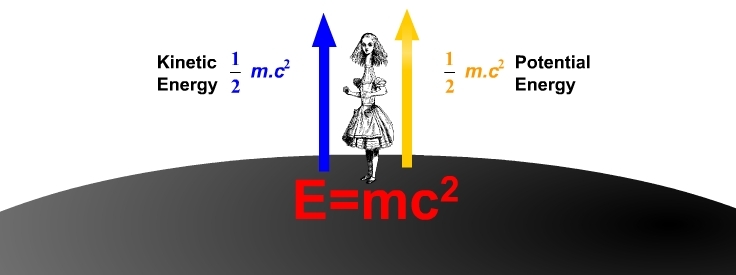
In this way, we have defined both the kinetic energies
and the potential energies of the ball along both axes.
In the figure, the blue arrows represent kinetic energies,
and the yellow and green arrows represent potential energies.
The total energy of the ball is determined
by the vector sum of the resultant vectors
of its potential and kinetic energies.
(Animated Figure 8)
Up to now, in our examples,
the man on the wagon has been trying to prevent the ball from falling.
From this point on, let us consider the opposite:
the man gradually increases the inclination of the platform,
and you try to keep the ball on the platform
by changing the pushing force of the locomotive.
To reach the equality E=mc²,
we assume that the locomotive has infinite pushing power.
In the animation below, you are in control of the locomotive.
While the man increases the inclination of the platform,
you will try to prevent the ball from falling.
You can adjust the pushing force of the locomotive
by moving the slider on it.
If you let the ball fall, press Reset and Play
to try again.
flash
In the animation above,
as you try to keep the ball on the platform,
you can see that the resultant vectors
of kinetic and potential energy grow larger and larger.
For an object that has energy E=mc²,
the magnitudes of the resultant vectors
of its potential and kinetic energies
have reached the value c,
and both vectors point in the same direction.
flash
The Alice Law is the future of physics.
Learn it and tell others about it.