BEHAVIOR OF LIGHT
(c+v) (c-v) PROOF

Han Erim
15 October 2009
Alice Law shows that the thesis stating that light propagates in vacuum
with speed c is wrong, and instead demonstrates that it moves with
speed c with respect to the body which is its arrival target. Since I
have explained in detail how this situation occurs in all versions of
Alice Law, I will not repeat it here and will only present the
animations and proof needed for the Alice Law Version 6 book.
Animation 1
– This is the animation of the proof made in the Alice Law Version 6
Book. The lights turn on and reach the walls of both parts. The speed
of the lights going toward the walls of the parts is, with respect to
the ground reference frame, necessarily (c+v) (c−v). The situation I
show here is the simplest form of the proof belonging to Alice Law.
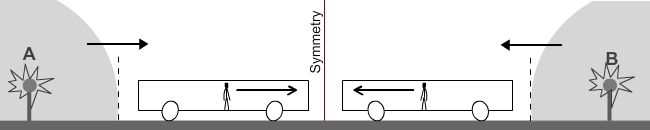
Animation 2
– In the previous animation there was a single light source and it was
inside the reference frames (the box parts). If we place the light
sources outside, the situation does not change and light behaves in
accordance with the (c+v) (c−v) mathematics. That is, light (i.e.
photons, i.e. electromagnetic waves) will move with speed c with
respect to the body which is the arrival target. For an observer
watching the event from the ground reference frame, the speed of the
lights going to the vehicles is (c+v) (c−v).
If, as shown in the animation, the lights are switched on when the
midpoints of the vehicles are on the symmetry axis, the observers
standing at the midpoints of the vehicles will see both lights as
having turned on simultaneously.
The more comprehensive proof which explains why light behaves in this
way is given below. This proof also shows, in a very interesting way,
that the “sum of velocities theorem” is valid for electromagnetic waves
as well.
Animation 3
– I first published this graph in my FIRST PAPER work. The graph is a
Path–Time–Velocity graph of the event we watched in Animation 2. The
graph starts at the moment when the lights are turned on. At this
instant, the midpoints of both vehicles are on the symmetry axis.
The event for which we are seeking a solution is this: There are two
vehicles moving in opposite directions with equal speeds. At what time
must we switch on the lights at points A and B so that the observers in
the vehicles see the lights coming toward them as having turned on
simultaneously? We use the symmetry principle for the situation of the
vehicles and the lights. With respect to the ground reference frame,
the events occurring in both vehicles will be simultaneous and equal.
Three conditions must be satisfied in order to solve the problem. These conditions are as follows:
- The lights must reach the front and rear of both vehicles simultaneously.
- The lights must reach both observers in the vehicles simultaneously.
- The lights must leave both vehicles simultaneously.
The following additional conditions must also be satisfied in the proof:
- The proof must be independent of the speeds of the vehicles.
- The proof must be independent of the lengths of the vehicles.
- The observers in the vehicles must measure the speed of the light coming to them as c, i.e. as a constant.
These subsidiary conditions are automatically satisfied in the proof,
because at the moment when the lights are turned on the distances
between the lamps and the observers are equal. (See Follow the Rabbit)
When we think about the behavior of light using the (c+v) (c−v)
mathematics, all of the conditions above are satisfied. If you move the
scrollbar downward, you can see at which positions (X axis) the lights
and the vehicles are at each time (Y axis).
What turns this graph into a proof of the existence of the (c+v) (c−v)
mathematics in nature is that it shows exactly when the lights must be
switched on. If we want the observers standing at the midpoints of the
vehicles to see both lights as having turned on at the same time, then
the lights must be switched on at the moment when the midpoints of both
vehicles reach the symmetry axis, that is, as shown here. For the
switching-on moment of the lights there is only a single option. This
situation makes the existence proof of (c+v) (c−v) without any
difficulty and in a very straightforward manner.
The special theory of relativity that is currently used by physicists,
represented by Albert Einstein’s mathematics, is helpless in the face
of the proof made here. Using Albert Einstein’s mathematics, no
solution can be obtained that would invalidate this proof. Because for
the choice of the switching-on moment of the lights there is only one
position, and this compulsory position for the lights immediately, from
the very beginning, puts an end to the mathematics proposed by Albert
Einstein for the special theory of relativity. There is nothing to do
but surrender.
The sections “Relativity of Simultaneity” and “Relative Velocity of
Light” in Alice Law Version 5 examine and explain this proof in great
detail. You can also read my later work “Follow the Rabbit” on this
subject. All of my works can be read online on my web site.
In Alice Law the special theory of relativity has been completely
rewritten from the ground up. In fact, I must say that I no longer feel
like calling it a theory, because it did not come only with a theory,
but together with a physical proof.
You will find the consequences of the (c+v) (c−v) mathematics, which
shapes the special theory of relativity, in my other works. Everything
I explain to you within Alice Law is new and has never been written
anywhere else before. For this reason, I have no doubt that you will
follow my writings with great interest.
With my best regards,
Han Erim