WAVE SPEED = WAVE FREQUENCY × WAVELENGTH


The product of a wave’s
wavelength and frequency gives the speed of the wave. Using this
fundamental equation, which is also valid for electromagnetic waves,
let us see how electromagnetic interaction is intertwined with
(c+v)(c−v) mathematics.
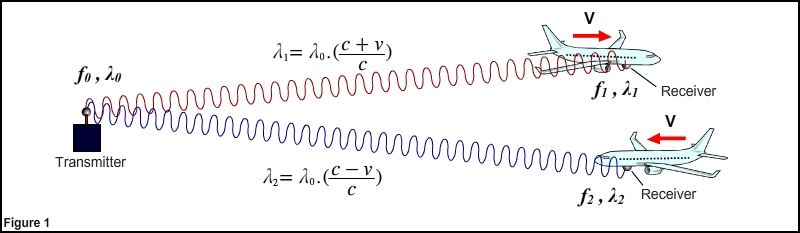
Let us assume that we are using a signal transmitter. Let the transmitter’s signal frequency be
f0,
and its wavelength be
λ0(*).
An airplane moving away from us will receive the signal—due to Doppler Shift—at frequency
f1
and wavelength
λ1.
An airplane approaching us will receive the signal at frequency
f2
and wavelength
λ2.
(Figure 1)
(*) Now please pay attention;
According to the observer on the receding airplane, the wavelength of the signal reaching him is
λ1.
But we are on the side of the signal transmitter, and the frequency of our transmitter is
f0.
If the frequency value of the transmitter is multiplied by the
wavelength of the signal detected on the airplane, the speed of the
signal traveling toward the airplane is obtained.
Speed of the signal going to the receding airplane
c1 = f0 . λ1
c1 > c
|
Similarly, for the airplane approaching the signal source, the equation is formed as follows:
Speed of the signal going to the approaching airplane
c2 = f0 . λ2
c2 < c
|
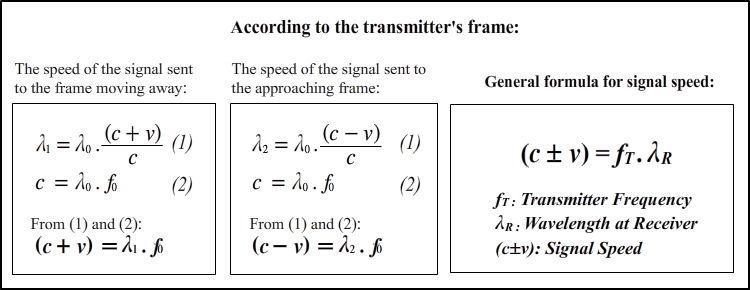
Therefore, we can express the two equations above as follows:
Signal Speed = Frequency of the Transmitter × Wavelength at the Receiver
This equation is the fundamental equation of electromagnetic interaction.
All errors and deficiencies in today’s Electromagnetic Theory arise from not knowing this equation.
The current theory has been built on the assumption that the speed of a signal is constant for all frames
(= c), which is extremely wrong.
The reason such a major mistake has been made is that the speed of a signal traveling to a moving frame
has never been measured until today.
|
I have now revealed where the mistake in Electromagnetic Theory comes from.
From this point on, I will proceed by taking the equation above as the basis.
(c+v)(c−v) Mathematics for Electromagnetic Theory
If we speak for Figure 1 above, the following equations apply for the
signal speeds traveling from the transmitter to the airplanes.
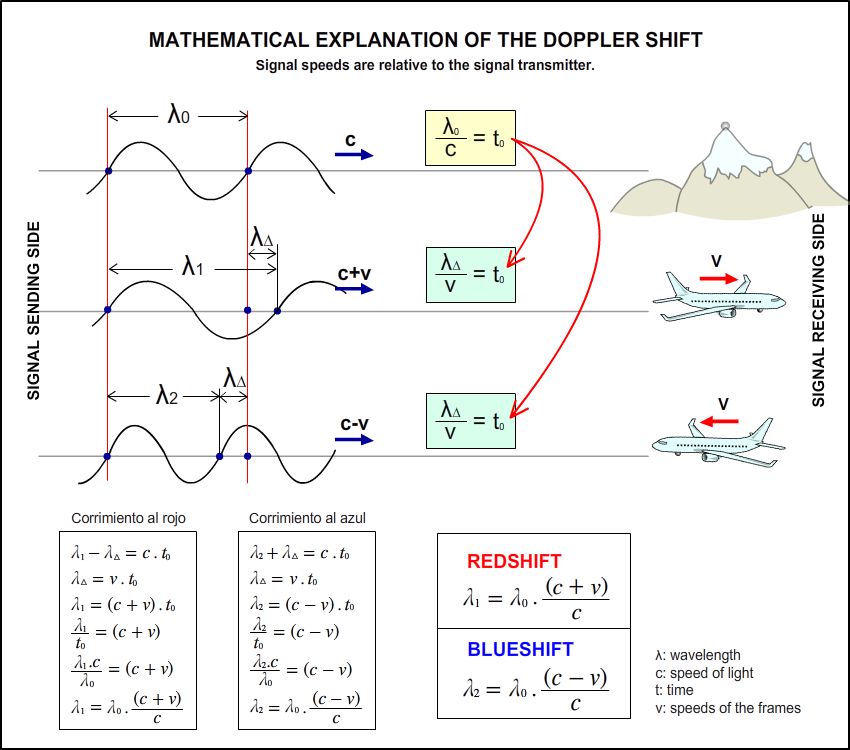
The “+v” value in the equations is the speed of the receding airplane,
and the “−v” value is the speed of the approaching airplane.
(The necessary explanation is given in the table below.)
c1 = f0 . λ1 = c + v
c2 = f0 . λ2 = c - v
|
(c+v)(c-v) Mathematics is the “Rule of Addition of Velocities” for electromagnetic waves.
Let us examine the signal speeds approaching the observers, considering the reference frames of the observers on the airplanes.
According to the observer on the receding airplane, the speed of the signal reaching him is as follows,
because the signal and the airplane move in the same direction:
signal speed = speed of the signal traveling toward the airplane − speed of the airplane
c = (c+v) - v
According to the observer on the approaching airplane, the speed of the signal reaching him is as follows,
because the signal and the airplane move toward each other:
signal speed = speed of the signal traveling toward the airplane + speed of the airplane
c = (c-v) + v
We see that, regardless
of the airplane’s direction, for an observer on the airplane the speed
of the signal reaching him is “c”.
The two equations above, which yield the constant c, are the
Rule of Addition of Velocities for electromagnetic waves.
Let us find the frequency of the signal reaching the observers on the airplanes:
We use the Wave Speed equation.
For the observer on the receding airplane: f1 = c / λ1
For the observer on the approaching airplane: f2 = c / λ2
As seen, we have confirmed a known situation within (c+v)(c-v) mathematics.
At this stage we can write a rule for electromagnetic interaction:
Whether a frame is in motion or not, in its own reference frame,
the speed of a signal coming toward it is always “c”.
|
The table below summarizes what has been explained here, using example values.
ALICE EQUATIONS
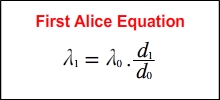
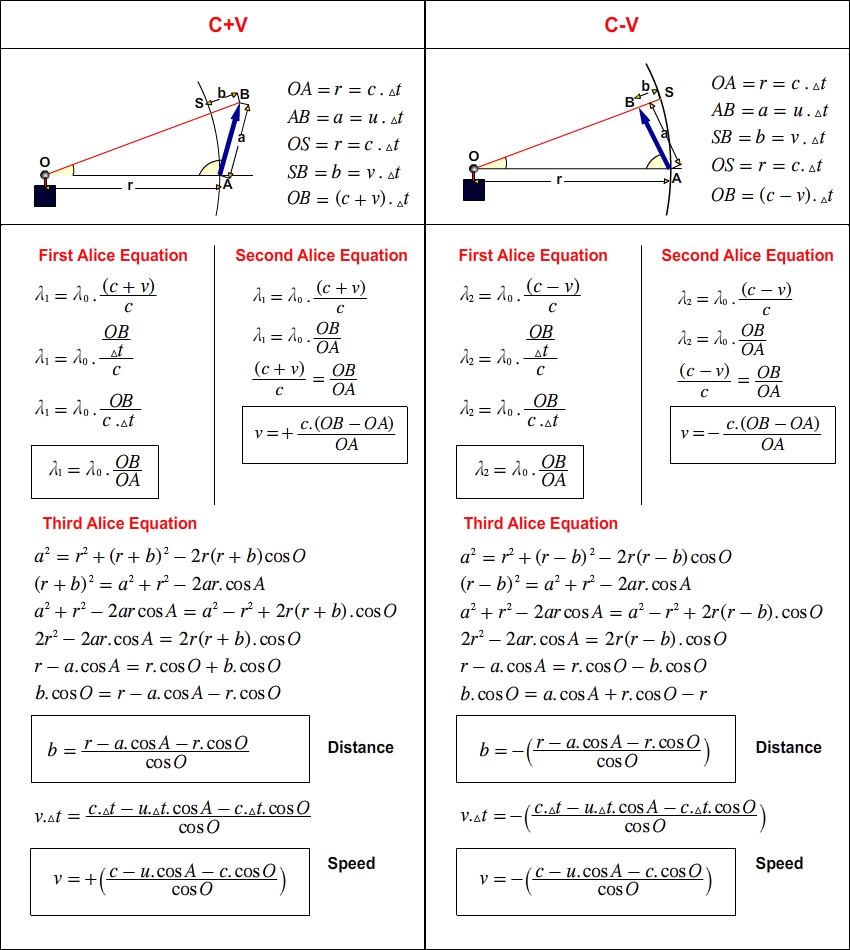
(c+v)(c−v) mathematics brings with it several important equations.
The first of these is an equation that expresses the change in
wavelength, in electromagnetic interaction between two frames moving
relative to each other, by using distances.
d0 = Distance between the frames at the moment the signal is emitted.
d1 = Distance between the frames at the moment the signal arrives.
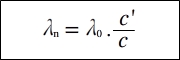
λ0 = Normal wavelength of the transmitter (λ0 = c / f0)
λ1 = Wavelength of the signal sent from the transmitter to a moving target (λ1 = (c±v) / f0)
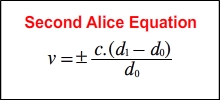
The value "v" in (c+v)(c−v) mathematics represents the rate at which
the frames move away from or toward each other, and at the same time
indicates the amount by which the signal’s speed deviates from the
speed of light. In our previous examples, since motion occurred
only along the X-axis, the velocities of the frames were used directly
as the value of "v". The equations below show how the value of "v" is
calculated in electromagnetic interaction between two frames moving in
any direction.
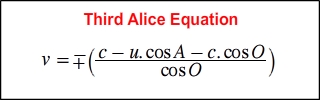
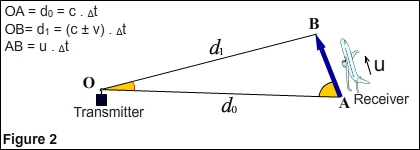
The derivation of these
equations is detailed below. The signal transmitter is at point "O".
The receiver is moving with velocity "u" in the direction of line "AB".
When the receiver is at point "A", a signal is emitted from point "O".
When the receiver reaches point "B", the signal also arrives at point
"B". In the figures, the length "SB = b" is related to the value "v"
through the equation "b = v · Δt", and calculations are based on this
relationship. If point "B" lies outside the circle centered at "O" with
radius "OA = r", the value of "v" is positive; if it lies inside, "v"
is negative.
THE THEORETICAL CONSEQUENCES OF (c+v)(c−v) MATHEMATICS
If (c+v)(c−v) mathematics is
experimentally confirmed, a major upheaval in the theory of physics
will be inevitable. First of all, a major deficiency in the mathematics
of Electromagnetic Theory will be eliminated, which would be a great
achievement. Relativity Theory would no longer be needed. As a result,
physics would undergo a significant simplification.
Interestingly, when the consequences of (c+v)(c−v) mathematics are
examined, we see that concepts such as time dilation, length
deformation, and simultaneity — which are also present in Relativity
Theory — appear here as well. However, since these concepts are based
on a different mathematical foundation, they carry different meanings
within (c+v)(c−v) mathematics. Under the name of Alice Law, I have
published many works investigating (c+v)(c−v) mathematics and its
consequences. You can find these publications at
www.aliceinphysics.com. I must admit that I realized quite late that
instead of Alice Law, I was actually dealing with Electromagnetic
Theory.
As we see here, the interesting behavior of electromagnetic waves based on (c+v)(c−v) mathematics will raise many questions.
We will encounter very challenging questions for which we may not yet have answers.
The foremost of these questions is undoubtedly:
“How can an electromagnetic wave know its destination, and how can it take that reference frame as its basis?”
I believe that correct answers can only be obtained through long and painstaking studies.
In its current form, (c+v)(c−v) mathematics only covers uniform linear
motion. It is incomplete for interactions between frames undergoing
accelerated motion, rotational motion, or other types of complex
motion. Eliminating this deficiency will carry Electromagnetic Theory
to a much more advanced level.
THE SPEED OF AN ELECTROMAGNETIC WAVE TRAVELING TOWARD A MOVING FRAME HAS NEVER BEEN MEASURED.
Dear Scientists,
The mathematics of Electromagnetic Theory is (c+v)(c−v) mathematics.
The only thing this mathematics currently needs is the measurement of the speed of a signal traveling toward a moving frame.
Once this is done, what is explained here will take its rightful place in science.
The BYTE SHIFT phenomenon I previously described is a good method to
verify (c+v)(c−v) mathematics. Of course, another method could also be
chosen.
I kindly ask you to raise your voices and support the urgent
performance of an experiment that will reveal (c+v)(c−v) mathematics.
Thank you for reading.
Han Erim