Today's Electromagnetic Theory does not cover the interaction
between frames that are in motion relative to each other. This
deficiency stems from a major negligence by physicists. Decisions were
made without measuring the speed of light moving toward a moving frame,
and as a result the electromagnetic theory was built upon incomplete
mathematics.

Naturally, I think you will say that BOTH events described are CORRECT. Because this is what we were taught in physics. However, this is not the case at all.
If 1 is true, 2 is false.
If 2 is true, 1 is false.
Here I will show you that 1 is correct and 2 is incorrect. The moment you understand that the situation described in EVENT 2 is impossible, you will see that physics becomes beautiful and fascinating for you.
Here, by giving you two examples, I will show you this deficiency. The
events I will describe are not complicated. You will not even hesitate
about them. But you will see that through these examples you become
aware that some things in physics have been misunderstood. Here I ask
you to first help yourself, and then help others. This should be the
important part.
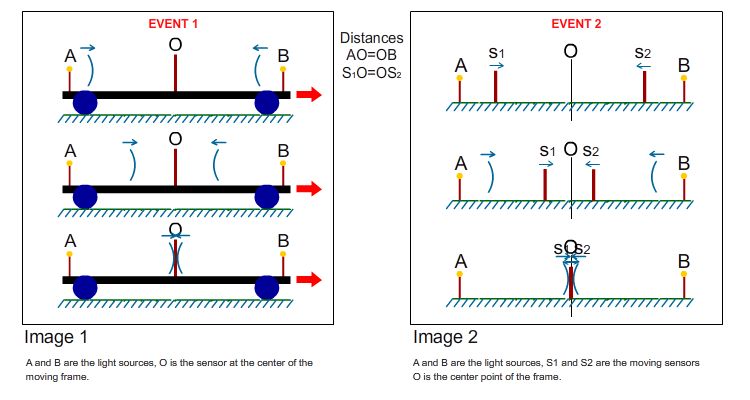
EVENT 1
We place two lamps on a frame in motion and place a light sensor at the
midpoint. If the lights turn on at the same time, they will arrive at
the center sensor simultaneously. (image 1)
EVENT 2
There are two light sensors located at equal distances to the right and
left of point O. The sensors approach point O at equal speeds. Meanwhile,
from behind the sensors and at equal distances to point O, we send two
light beams. If the lights and sensors meet at point O at the same time,
then the sensors will have received the light simultaneously. (image 2)

Naturally, I think you will say that BOTH events described are CORRECT. Because this is what we were taught in physics. However, this is not the case at all.
If 1 is true, 2 is false.
If 2 is true, 1 is false.
Here I will show you that 1 is correct and 2 is incorrect. The moment you understand that the situation described in EVENT 2 is impossible, you will see that physics becomes beautiful and fascinating for you.
Flash
First, let me introduce the device we will use here. The
device is a vacuumed tube with a light source on each side. Inside the
tube are two carriages moving along a rail. On these carriages, there
are two sensors located at equal distances from the center on both
sides, and there is a third sensor at the exact center of the carriage.
These sensors are light-sensitive and detect the moment the light
reaches the sides and center of the carriage. The carriages can measure
the speed of incoming light. Using the control panel, the speed of the
carriages can be set to any value between 0 and c (speed of light). The
two lamps on either side of the tube can be turned on at any desired
moment using a push-button mechanism. The device is fully controlled
externally, and here you will be controlling it. The figure below shows
the device and its parts. Please examine it.
The device is designed in accordance with the principle of symmetry.
Meaning:
Both lights are always triggered simultaneously.
The speeds of the carriages are always equal but in opposite directions.
The distances of the carriages to the symmetry axis are always equal.
The time at which the lights are triggered is adjusted using the small brown triangular buttons that can be shifted right or left. The light is triggered at the moment this button touches the orange triangular button located at the lower-middle position of the carriage.
Since the device is designed according to the principle of symmetry, we can easily say the following: The events occurring on the left side of the symmetry axis will occur in the same manner on the right side. For example, at the moment when light traveling from the left reaches a carriage, light traveling from the right will also reach the other carriage. We need not hesitate about this.
Our goal is to ensure that while the carriages are in motion, the light coming from both sides reaches the center sensor of the carriage at the same time. If we turn on the lights too early or too late while the carriages are moving, naturally the lights will not reach the center sensor simultaneously. Only if the lights are triggered at the correct time will this occur. Therefore, since we can control the speeds of the carriages and the firing times of the lights as we wish, there must and will certainly exist a condition in which both lights reach the center sensor simultaneously.
Let us express the paragraph above as a rule:
I do not think you will object to the golden rule, because it is obvious that there must exist such a condition where the golden rule is satisfied. The importance of this rule is that if we can find the conditions that satisfy the Golden Rule, then we will also be able to answer the question "What is the Major Deficiency in Electromagnetic Theory?" Use the device below and try to satisfy the Golden Rule.
The device is designed in accordance with the principle of symmetry.
Meaning:
Both lights are always triggered simultaneously.
The speeds of the carriages are always equal but in opposite directions.
The distances of the carriages to the symmetry axis are always equal.
The time at which the lights are triggered is adjusted using the small brown triangular buttons that can be shifted right or left. The light is triggered at the moment this button touches the orange triangular button located at the lower-middle position of the carriage.
Since the device is designed according to the principle of symmetry, we can easily say the following: The events occurring on the left side of the symmetry axis will occur in the same manner on the right side. For example, at the moment when light traveling from the left reaches a carriage, light traveling from the right will also reach the other carriage. We need not hesitate about this.
Our goal is to ensure that while the carriages are in motion, the light coming from both sides reaches the center sensor of the carriage at the same time. If we turn on the lights too early or too late while the carriages are moving, naturally the lights will not reach the center sensor simultaneously. Only if the lights are triggered at the correct time will this occur. Therefore, since we can control the speeds of the carriages and the firing times of the lights as we wish, there must and will certainly exist a condition in which both lights reach the center sensor simultaneously.
Let us express the paragraph above as a rule:
| THE GOLDEN RULE: Since we can control the speeds of the carriages and the firing times of the lights as we wish, a condition in which the lights reach the center sensor simultaneously must and certainly exists. Furthermore, since the device operates according to the principle of symmetry, the lights will reach the center sensors of both carriages at the same time. |
I do not think you will object to the golden rule, because it is obvious that there must exist such a condition where the golden rule is satisfied. The importance of this rule is that if we can find the conditions that satisfy the Golden Rule, then we will also be able to answer the question "What is the Major Deficiency in Electromagnetic Theory?" Use the device below and try to satisfy the Golden Rule.
Flash
If you think the answer is simple, let me tell you that you
are mistaken. You might think that there is only one possible condition
that can satisfy the golden rule, and that it must be the following: at
the moment the center of the carriages reaches the symmetry axis, the
lights must also reach the symmetry axis; then the golden rule will be
satisfied (Figure 2. Show
Button) Although such a proposition may appear reasonable, it is
absolutely incorrect.
It is incorrect because the sensors located on both sides of the carriage show us that this logic is wrong. Let us consider a single carriage. In physics, we know with certainty that if we were to place a lamp at the center of the carriage and turn it on, the light would reach the sensors on both sides simultaneously. Whether the carriage is moving or not does not change this. Conversely, if we place lamps on both sides of the carriage and turn them on simultaneously, the light would reach the center sensor at the same time. Again, whether the carriage is moving or not does not change this. Thus, the following necessary result exists: For the lights to reach the center sensor simultaneously, the lights must first reach the sensors on the sides simultaneously. Only when this necessary condition is met can the lights arrive at the center sensor at the same time. (Figure 3)
It is incorrect because the sensors located on both sides of the carriage show us that this logic is wrong. Let us consider a single carriage. In physics, we know with certainty that if we were to place a lamp at the center of the carriage and turn it on, the light would reach the sensors on both sides simultaneously. Whether the carriage is moving or not does not change this. Conversely, if we place lamps on both sides of the carriage and turn them on simultaneously, the light would reach the center sensor at the same time. Again, whether the carriage is moving or not does not change this. Thus, the following necessary result exists: For the lights to reach the center sensor simultaneously, the lights must first reach the sensors on the sides simultaneously. Only when this necessary condition is met can the lights arrive at the center sensor at the same time. (Figure 3)
Flash
Now we see that things suddenly become complicated. Because,
if we examine the logic we have just followed, we can easily see that
the lights will not reach the side sensors simultaneously. We are faced
with a real paradox. Let us clearly write this paradox in three
statements.
When the center points of the carriages reach the symmetry axis, let the lights reach the side sensors. But in this case, the lights will NOT reach the center sensors simultaneously. That is the first point (Figure 4-A)
If the lights meet the center sensors at the symmetry axis, then the lights will NOT have reached the side sensors simultaneously. That is the second point (Figure 4-B)
No solution that violates the principle of symmetry can be valid. The lights must reach the side sensors of both carriages simultaneously, and then must reach the center sensor simultaneously. That is the third point.
When the center points of the carriages reach the symmetry axis, let the lights reach the side sensors. But in this case, the lights will NOT reach the center sensors simultaneously. That is the first point (Figure 4-A)
If the lights meet the center sensors at the symmetry axis, then the lights will NOT have reached the side sensors simultaneously. That is the second point (Figure 4-B)
No solution that violates the principle of symmetry can be valid. The lights must reach the side sensors of both carriages simultaneously, and then must reach the center sensor simultaneously. That is the third point.
Flash
We cannot claim that a solution satisfying the golden rule is
impossible, because it is clear that such a solution must exist. You are
sending light from both sides, yet under no circumstances can the light
reach the center sensor simultaneously. Suggesting such a claim would be
truly ridiculous. On the other hand, to claim that the light could reach
the center sensor simultaneously without first reaching the side sensors
simultaneously would violate all our existing physical knowledge — and
that would be even more ridiculous. Another factor making our task
difficult is the principle of symmetry. We cannot propose a solution
that violates symmetry and satisfies all necessary conditions for only a
single carriage.
As we see, the device restricts all our options. It does not allow any solution that contradicts its design or principles. On the other hand, the truth is that the physical law of nature — whatever it is — is represented by the condition that satisfies the Golden Rule. We must find this.
Now it is time to address our physicist friends. You may think you know Electromagnetic Theory, and that by using your existing knowledge and not violating the principles described here, you can produce a solution that satisfies the Golden Rule. However, you will see that the device will not allow such a solution in any way. In your proposed solution, the light must reach the side sensors of both carriages simultaneously, then reach the center sensor simultaneously, and throughout this process the principle of symmetry must not be violated. Additionally, you must mathematically show every step in your proposed solution, including the positions of the light and the carriages at any time t. Let me state clearly: you cannot solve this paradox with your current knowledge. The mathematics of Electromagnetic Theory cannot solve this paradox. The education you received in physics and your current accumulated knowledge will fail you here. Were I in your place at this stage, in response to this open challenge, I would take pen and paper and try to find a solution that satisfies the Golden Rule.
It is a fact that if one wishes to reach the Golden Rule, some deficiencies in our current physical knowledge must be acknowledged, and here I am talking about the deficiency in Electromagnetic Theory. The solution is not found within Albert Einstein's mathematics either. Using his mathematical concepts such as space contraction and time dilation cannot solve this paradox. This means that if you want to find the Golden Rule, you must continue on your own from this point forward.
The Golden Rule
To reach the solution, we must focus our thoughts on the light emitted from the device. As we know, light consists of photons. A beam of light contains countless photons. Therefore, the light beam traveling toward the carriages will also contain countless photons. Based on this, let us think not in terms of the light beam as a whole, but in terms of the individual photons within the beam, and propose the following: each photon travels at the constant speed c relative to its own arrival target. This kind of proposition is, of course, outside the knowledge of current physics, but that does not matter. Because from the moment we understand that even Einstein’s mathematics cannot produce a solution, the threshold that restricts us is naturally surpassed. What matters is to find the solution that satisfies the Golden Rule.
If we think further, such a solution would require the initially single light beam to gradually split, because each photon moves at speed c relative to its own arrival target. In our example, since the arrival targets of the photons are two carriages moving in opposite directions, the light beam will split into two parts. (Figure 5)
As we see, the device restricts all our options. It does not allow any solution that contradicts its design or principles. On the other hand, the truth is that the physical law of nature — whatever it is — is represented by the condition that satisfies the Golden Rule. We must find this.
Now it is time to address our physicist friends. You may think you know Electromagnetic Theory, and that by using your existing knowledge and not violating the principles described here, you can produce a solution that satisfies the Golden Rule. However, you will see that the device will not allow such a solution in any way. In your proposed solution, the light must reach the side sensors of both carriages simultaneously, then reach the center sensor simultaneously, and throughout this process the principle of symmetry must not be violated. Additionally, you must mathematically show every step in your proposed solution, including the positions of the light and the carriages at any time t. Let me state clearly: you cannot solve this paradox with your current knowledge. The mathematics of Electromagnetic Theory cannot solve this paradox. The education you received in physics and your current accumulated knowledge will fail you here. Were I in your place at this stage, in response to this open challenge, I would take pen and paper and try to find a solution that satisfies the Golden Rule.
It is a fact that if one wishes to reach the Golden Rule, some deficiencies in our current physical knowledge must be acknowledged, and here I am talking about the deficiency in Electromagnetic Theory. The solution is not found within Albert Einstein's mathematics either. Using his mathematical concepts such as space contraction and time dilation cannot solve this paradox. This means that if you want to find the Golden Rule, you must continue on your own from this point forward.
The Golden Rule
To reach the solution, we must focus our thoughts on the light emitted from the device. As we know, light consists of photons. A beam of light contains countless photons. Therefore, the light beam traveling toward the carriages will also contain countless photons. Based on this, let us think not in terms of the light beam as a whole, but in terms of the individual photons within the beam, and propose the following: each photon travels at the constant speed c relative to its own arrival target. This kind of proposition is, of course, outside the knowledge of current physics, but that does not matter. Because from the moment we understand that even Einstein’s mathematics cannot produce a solution, the threshold that restricts us is naturally surpassed. What matters is to find the solution that satisfies the Golden Rule.
If we think further, such a solution would require the initially single light beam to gradually split, because each photon moves at speed c relative to its own arrival target. In our example, since the arrival targets of the photons are two carriages moving in opposite directions, the light beam will split into two parts. (Figure 5)
Flash
“Each photon travels
at the constant speed c relative to
its own arrival target” — this new proposition is sufficient to
reach the solution.
In this case the Golden Rule is satisfied without violating any
principle.
The behavior of light will be as follows: each photon will move at speed
c relative to its own target carriage. Using the device below, you can
obtain the Golden Rule. (Figure
6)
Flash
The solution also shows without any doubt when the lights
must be triggered. If it is desired that the lights reach the center
sensors of the carriages simultaneously, then there is only one possible
triggering condition: when the centers of the carriages reach the
symmetry axis, the lights must be turned on. In this case, all necessary
conditions are satisfied. First, the lights reach the side sensors of
the carriages, and then they reach the center sensor. The symmetry
principle is also preserved. Regardless of their speed, note that the
carriages always measure the incoming light speed as c under all
conditions (use the Checkbox in the figure).
From this point on, the rest is easy. The mathematics of Electromagnetic Theory must be (c+v)(c−v), as required by this behavior.
Han Erim
From this point on, the rest is easy. The mathematics of Electromagnetic Theory must be (c+v)(c−v), as required by this behavior.
Han Erim

Link