Banner
 How space
deformation occurs and how it is calculated is shown in detail in my work titled
Space Deformation.
Here, I present the relationship between space deformation and the Doppler Effect.
How space
deformation occurs and how it is calculated is shown in detail in my work titled
Space Deformation.
Here, I present the relationship between space deformation and the Doppler Effect.

As seen in the space deformation study, the following equation exists.
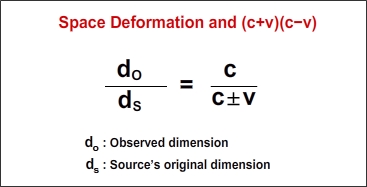 (1)
(1)
The frequency change in an observed
electromagnetic wave due to the Doppler Effect is given by the following equation.
Reference: "Doppler Effect and Special Relativity"
 (2)
(2)
Using equations
(1) and (2), the relationship between the frequency change in electromagnetic waves
and space deformation is easily established (3).
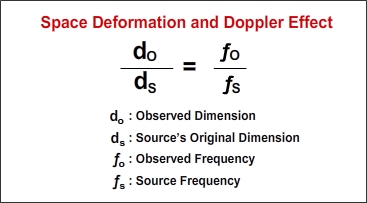 (3)
(3)
TIME DILATION
flash1
To reveal the
relationship between time dilation and the Doppler Effect,
I followed this approach:
Special
Relativity and Time Synchronization is the basis for my work, and I rewrote the source
code of the first animation, which was written based on (c+v)(c-v) mathematics,
in a simplified manner to give the same result. From there, I calculated how the
tick-tock intervals of the clock on the GHOST image changed. I compared the obtained
interval with those of the clock on the SPRING.
As seen from the calculations, the ratio of the tick-tock
intervals of both clocks is equal to c/(c±v). (Here, c is the speed of light,
v is the relative velocity between the observer and the spring). Since the observer’s clock and the
spring clock run synchronously, the same ratio is valid between the observer’s clock and the
clock on the ghost.
As a result, the effect we observe on moving clocks depends
on the ratio c/(c±v) (4).
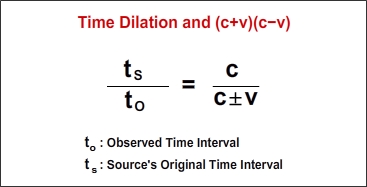 (4)
(4)
Since the ratio c/(c±v) also
determines the frequency change in electromagnetic waves, the relationship
between time dilation and the Doppler Effect is thus revealed (5).
 (5)
(5)
You might know a programming language other than
ActionScript. Therefore, I also provide the source code of the animation here.
If you are familiar with Flash CS3 ActionScript 3.0, you can
download the source code as a .fla file.
/*
=============================
This source code is under
GNU GENERAL PUBLIC LICENSE
Copyright © 2009 Han Erim
ALICE LAW
http://www.aliceinphysics.com
=============================
*/
var speed:int=-2;
var relativeSpeed:int=-10;
var rot:int=5;
var springRotation:Number=2;
var ghostRotation:Number=0;
var speedOfLight:int=10;
var distance:Number=0;
var arrivalTime:Number;
var sign:int= 1;
var rememberSpring:Number=0;
var rememberGhost:Number=0;
addEventListener(Event.ENTER_FRAME,action);
function action(e:Event):void {
observer.x<=-400 || observer.x>=400 ? speed=-1*speed : "" ;
//c-v
observer.x >0 && speed<0 ? relativeSpeed=
-Math.abs(speed) : "";
observer.x <0 && speed>0 ? relativeSpeed=
-Math.abs(speed) : "";
//c+v
observer.x >0 && speed>0 ? relativeSpeed= Math.abs(speed)
: "";
observer.x <0 && speed<0 ? relativeSpeed= Math.abs(speed)
: "";
alo.text=String(relativeSpeed);
observer.x>0 ? observer.bottom.scaleX=1 : observer.bottom.scaleX=-1;
//=====
observer.x+=speed;
distance=spring.x-observer.x;
arrivalTime=distance/speedOfLight;
observer.x>0 && relativeSpeed>0 ? sign=-1 : "";
observer.x>0 && relativeSpeed<0 ? sign=1 : "";
observer.x<0 && relativeSpeed>0 ? sign=-1 : "";
observer.x<0 && relativeSpeed<0 ? sign=1 : "";
ghost.x= sign*Math.abs(relativeSpeed)*arrivalTime;
//==========
observer.x>0 && relativeSpeed<0 ? sign=1 : "";
observer.x<0 && relativeSpeed>0 ? sign=-1 : "";
observer.x<0 && relativeSpeed<0 ? sign=-1 : "";
observer.x>0 && relativeSpeed>0 ? sign=1 : "";
springRotation+=rot;
spring.second.rotation=springRotation;
spring_timeInterval.text=String(springRotation-rememberSpring);
rememberSpring=springRotation;
ghostRotation=springRotation+sign*arrivalTime*rot;
ghost.second.rotation=ghostRotation;
ghost_timeInterval.text=String(ghostRotation-rememberGhost);
rememberGhost=ghostRotation;
proportion1.text=String(Number(spring_timeInterval.text)/Number(ghost_timeInterval.text));
observer.x>0 && relativeSpeed>0 ? sign=-1 : "";
observer.x>0 && relativeSpeed<0 ? sign=1 : "";
observer.x<0 && relativeSpeed>0 ? sign=-1 : "";
observer.x<0 && relativeSpeed<0 ? sign=1 : "";
proportion2.text=String(speedOfLight/(sign*Math.abs(relativeSpeed)+speedOfLight));
}
|
SIMULTANEITY AND PERCEPTION SPEED
flash2
EVENT PERCEPTION SPEED AND SIMULTANEITY
Our speed of perceiving events is a measure of how fast
the events we see on the GHOST pass for us. The ticking speed of the clock
we see on the GHOST is also a measure of how fast we perceive the events
happening on the ghost.
Naturally, the smaller the tick-tock intervals
of the clock on the ghost, the faster we perceive the events occurring on the ghost.
Perception speed and time dilation are inversely proportional.
To demonstrate the equality, I refer to my publication
Simultaneity and Special Relativity. As seen in the animation, all three reference
systems start watching the television broadcast at the same time. However, again
as seen, the flow rate of the broadcast is different for each of the three reference systems.
We know that the signals from the TV station will
reach each of the three reference systems at the speed of light, c. Therefore,
the following equation holds among the reference systems.
d = c.t = (c-v).t1 = (c+v).t2
Here, the values of t, t1, and t2 represent the time durations
indicating the flow rate of the broadcast, and t1 > t > t2. Using this equation,
we can calculate the flow speed of the television broadcast for viewers in moving airplanes (6).
 (6)
(6)
ERIM EQUATIONS AND RESULTS
Our sensitive measurement instruments can detect even
very small Doppler effects. This also means that the effects of Special Relativity
can be observed and measured. It is truly important knowledge to understand
that the effects of the Doppler shift and Special Relativity occur simultaneously.
I feel the pride and joy of being the first person to access
this knowledge. I wanted to name these equations after myself.
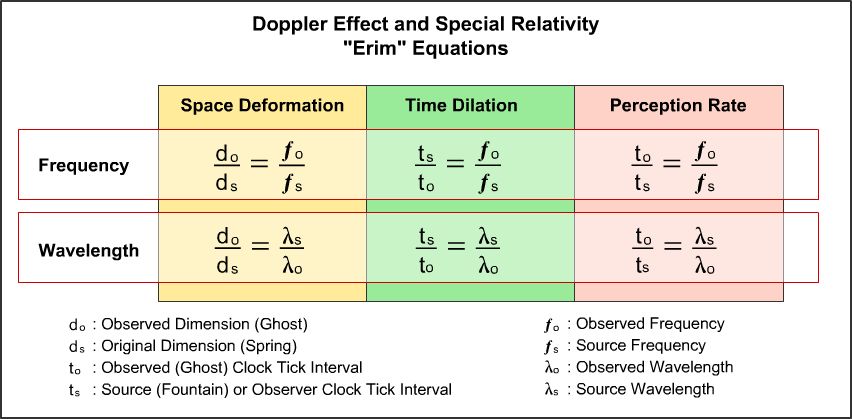
The above equations were officially recorded
by Han Erim at the 37th Notary of Beyoglu, Republic of Turkey,
on December 29, 2009 under No: 35035.
In the equations, we can use values for ds, ts
, ƒs, λs
either from our own reference system or from any reference system that
is stationary relative to ours.