banner
Image and Source
Han Erim
May 7, 2012

IMAGE AND SOURCE
The Alice Law Version 5 program I released in 2005 was a major breakthrough in relativity. However, in the following years, after working on the topic of Image and Source and seeing the results, I was shocked to realize how many critical gaps there were in relativity. I can say this with certainty: without understanding the concept of Image and Source, it is impossible to fully grasp electromagnetic interaction, relativity, or even physics itself. I now state this openly everywhere.
The concept of Image and Source was first introduced into the Alice Law in November 2009 with the release of my publication "Ghost and Spring". With it, Alice Law’s Theory of Relativity closed two major gaps: time dilation and dimensional deformation.
The concepts of Image and Source refer to two aspects of an object. The image is the object's appearance, while the source is the object itself. All objects emit electromagnetic waves either by reflecting incoming light or by generating it themselves. We see by detecting these electromagnetic waves coming from objects. The key point is that when we look at something, we are not seeing the object itself but the image shown to us by the signals emitted from it.
In the Alice Law, the image of an object is called a GHOST, and the object itself is called a SPRING. (In English, perhaps the word “Fountain” would be more accurate than “Spring”, but here it is referred to as Spring.) Springs are the electromagnetic sources — the physical objects themselves. Ghosts are the visual representations created by the radiation emitted from the springs.
The concepts of Ghost and Spring are especially important for relativity because effects such as time dilation and dimensional deformation occur on the image of objects. In this regard, the Theory of Relativity in the Alice Law differs significantly in both logic and outcome from the one currently in use.
flash
Figure 1 Although our topic is electromagnetic interaction, it’s good to begin with an example involving sound.
Imagine a fast-moving ambulance with its siren on. When the sound reaches an observer, they will look toward the direction the sound came from. If the ambulance passes from a far enough distance and is fast enough, the observer will not see the ambulance where they are looking. Because there will be a significant discrepancy between the position of the sound and the actual position of the ambulance. You’ve probably experienced something similar yourself. While the speed of sound — 340 meters per second — is quite fast, in daily life it’s still slow enough for us to observe such situations.
flash
Figure 2 The ambulance example from the previous page, though based on sound, is equally valid for light. If light traveled at 340 m/s instead of 300,000 km/s, we would frequently encounter very similar phenomena in everyday life.
In this example, instead of sending out siren sounds, the ambulance sends out its image. The signals (electromagnetic waves) carrying the image of the ambulance reach the observer, who then looks toward the direction from which the signal came. But there is a subtle difference between sound and light: this time the observer actually sees the ambulance’s image in that direction, because the signals arrived from there. However, since the ambulance continued to move after emitting the signal, by the time the signal reaches the observer, the ambulance is already in a different location.
This illustrates the definitions of Image and Source. In the Alice Law, the ambulance itself is called the SPRING, while what the observer sees is the ambulance’s image — the GHOST. Such specific naming is essential in relativity. When we say "the spring of the object is at this coordinate and its ghost is at that coordinate", the meaning is clear and precise.
flash
Figure 3 Of course, light travels at an incredible speed of 300,000 km/s. Therefore, to truly observe the effects of Ghost and Spring, we need long distances and high speeds. These effects become especially prominent in the observation of distant celestial bodies.
Here, the observer is looking at the planet Neptune through a telescope. We consider the electromagnetic waves (signals) emitted from Neptune when it was at position A. These signals carry the image of the planet to the observer. While the signals travel toward the observer, the planet continues on its orbit. When the signals reach the observer, they see Neptune at position A, even though the planet is now at position B.
Therefore, we can always speak of two separate situations: the observed situation and the actual situation. What we see are always image representations — ghosts. Ghosts are visible to us, but they do not represent the real, current state. In contrast, the actual objects — the Springs — reflect the true state, but are never directly seen.
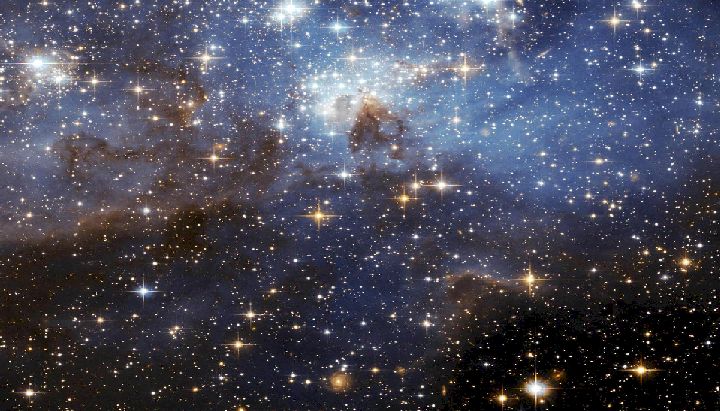
The best example of the Ghost and Spring concept is, of course, the sky. What we see is a view of the sky from a moment in the past that has traveled to us. When we look at the stars, we are seeing them as they were millions of years ago. These images have traveled through space for thousands or millions of years to reach us. Some of the stars we see may have ceased to exist long ago, but we still perceive them as if they were there. The sky is truly a paradise of ghosts.
In fact, this aspect of the sky is something you probably already know. But of course, the topic of Ghost and Spring isn’t this simple. The sky only shows us the tip of the iceberg. Once you grab that tip and begin to follow it, you’ll find the subject becomes increasingly deep and complex.
flash
Figure 4 Normally, the electromagnetic radiation of objects is continuous. Let's now turn the animation we previously saw into a continuous one.
Signals emitted from the planet reach the observer. The observer looks toward the direction the signal came from and sees the planet’s image — its ghost — in that direction. The planet itself (the Spring) will never be seen.
To make the details of the phenomenon easier to observe, we send the signals in discrete intervals in this animation. You can use the slider to reduce the interval between signal emissions and speed up the animation.
From the information we've gathered so far, we reach an important conclusion: The Ghost and Spring of a moving object are always located at different coordinates. The faster the motion and the farther the observation distance, the greater the separation between the coordinates of the Ghost and the Spring.
flash
Figure 5 Here, we are dealing with principles. Naturally, we can't run animations at the speed of light, but that’s not so important. What matters is understanding how light behaves and being able to observe the fundamental principles.
In this animation, a flashlight is being directed toward the observer. Light beams from the flashlight travel toward the observer. Use your mouse to drag the flashlight and observe where the observer sees it.
A beam of light contains countless photons. In the animation, each small yellow rectangle represents a single photon (a single electromagnetic wave). Each photon travels in a straight line toward its target.
Another conclusion can be drawn here: An electromagnetic wave always travels in a straight line. However, if the light source and the target are moving relative to each other, the path of light will appear curved.
flash
Figure 6 Where does the ghost of an object appear?
This is actually a very good question, because when you start investigating it, you will eventually arrive at the (c+v)(c−v) mathematics and the concept of fields. This is another path that leads to the Relativity Theory of the Alice Law.
In this example, the observer is stationary and the ball is in motion. So, it's quite easy to answer where the ghost will appear. The observer will see the ghost of the ball at the point in their own reference frame where the signal was emitted.
flash
Figure 7 When the observer is in motion and the ball is stationary, where will the observer see the ball’s ghost?
The question suddenly becomes more difficult, doesn’t it? Let me note right away that without an understanding of FIELD concepts, this is truly a difficult question to answer. I’ll give a short explanation here, since similar situations will appear frequently in later sections.
The observer is moving in the direction of the red arrow. We consider a signal emitted from the ball when it was at [x1, y1, z1] in the observer’s coordinate system. When that signal reaches the observer, the observer will see the ghost of the ball at [x1, y1, z1] — the same point where the signal was emitted according to their frame. At that moment, the ball’s actual position (in the observer’s frame) will be at [x2, y2, z2]. If you check the “Show Field” option in the radio buttons, you’ll find it easier to interpret what’s happening.
|
flash
|
Figure 8 Let's consider objects moving relative to one another. Assume we have a teleportation device and we can teleport ourselves onto any of these objects.
We teleport ourselves onto one of the objects. Can we say what speed we’re moving at? No, we can’t — because without referring to another reference frame, we can't even know whether we’re moving. We can only state our speed relative to other objects. On the other hand, we can also assume the object we're on is stationary. We can say: I am at rest, and the others are moving.
Do you understand this rule? If you truly grasp what’s being said here, there’s no chance you’ll be confused from now on. In fact, this is a very, very old principle being discussed.
|
flash
Figure 9 In our first example, the observer was stationary and the ball was moving. In the second example, the observer was moving and the ball was stationary. So in fact, both events are completely equivalent. It doesn’t matter whether it’s the observer, the ball, or both moving — what matters is that the two reference frames are moving relative to each other.
Where the observer sees the ball is easily understood when considered from the observer’s reference frame. The observer’s motion, direction, or even speed doesn’t matter. Even if the observer is moving, we can treat the observer as stationary and the ball as moving to determine where the ghost will appear.
flash
Figure 10 This section includes a summary of what we've seen so far — starring Alice and the Mad Hatter.
Image signals from Alice are being sent to the Mad Hatter, and image signals from the Hatter are being sent to Alice. In other words, both are seeing each other. Drag Alice and the Hatter with your mouse — this will change the position of their respective ghosts.
Let’s assume there is a symmetry axis at the midpoint between Alice and the Hatter. The events on both sides of this symmetry axis occur equally. When we drag Alice with the mouse, whatever effect occurs for her will also occur simultaneously for the Hatter. It doesn’t matter which one is moving.
About Ghost and Spring
In this section, we were introduced to the concepts of Ghost and Spring, focusing heavily on their positions. Of course, the topic of Ghost and Spring is not this simple or limited to what we’ve seen here. This subject has great importance in the Theory of Relativity because effects such as time dilation and length contraction occur entirely on the visual images — the ghosts — of objects.
This topic is also of vital importance within Electromagnetic Theory. Because without understanding it, it’s not possible to fully grasp electromagnetic interactions.
Let’s put aside the scientific side for a moment. Ghost and Spring is actually a part of general knowledge. This subject falls entirely within the scope of basic physics. It’s something that should be taught and learned even at the high school level — because it allows us to understand and interpret the universe we live in.
link