Banner
Experiment of the Alice Law
Han Erim
May 7, 2012

EXPERIMENT OF THE ALICE LAW
After I started working on physics, what surprised me the most
was seeing how ownerless physics is. Some important experiments
that could guide us about the general theory of physics have never
been brought up or conducted. As a result, the general theory of
physics—painfully—remains entirely based on assumptions and methods.
Can the general theory of physics be built on assumptions? You are
bound to make a mistake somewhere. The mistake made in electromagnetic
theory is the best example of this.
In this section, I will share my own views on how the (c+v)(c-v)
mathematics of electromagnetic theory can be experimentally verified.
This experiment could demonstrate that electromagnetic interaction
occurs through fields and that light travels within fields.
The logical principle of the experiment is based on detecting
whether light carries the momentum of its emitting source.
I hope the proposed experiment is conducted under the best possible
conditions and as soon as possible. Of course, other experiments
can also be planned and conducted to verify the (c+v)(c-v) mathematics.
As shown in the figure, there are two frames, A and B, moving in
opposite directions along their own X axes.
![]()
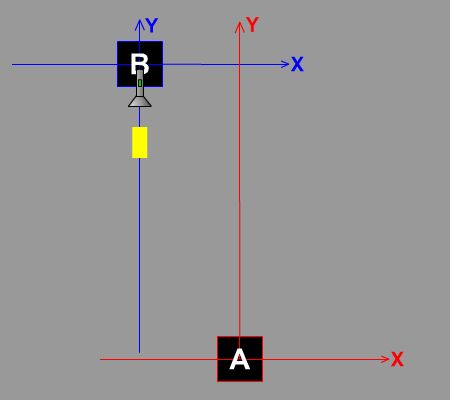
In frame B, there is a lamp acting as a light source. We assume
the lamp produces light in the form of a small, non-dispersing packet.
Our question is: At what point should frame B
emit the light so that it can reach frame A?
Let me say this openly in front of everyone: No physicist today
knows the answer to this question. Their inability to answer such a
question points to a major lack of knowledge in physics. Because this
kind of information is not something that requires special expertise.
All similar questions, which fall within the scope of fundamental
physics knowledge, should have been definitively answered in physics.
If someone says “I know the answer,” just laugh and move on,
because they’re obviously bluffing. If they really knew, they would
also know what I’ve written here. No matter who it is, their answer
to this question is nothing more than a personal guess. And this is
precisely what is dangerous in physics—thinking you know. Because
once assumptions are treated as facts, something is bound to break.
The answer to the question relates to whether light carries the
momentum of the source from which it is emitted. Therefore, this
question can be answered based on two different assumptions.
We will analyze both responses here. As a result of these analyses,
we will see whether it is possible to design an experiment that can
reveal the difference between the two views.
|
flash1
|
1st Alternative:
Light carries the momentum of the source from which it is emitted.
Let’s drop a stone from the mast of a ship and repeat this
a few times. Whether the ship is stationary or moving, the stone
will always fall in the same spot. Because the stone moves together
with the ship and has momentum in the direction the ship is moving.
We can apply this example to our case.
For simplicity, let’s consider frame A as stationary. If light
carries the momentum of its source, then it will follow the blue
Y-axis that belongs to frame B. Just like the stone example above,
the light will retain the velocity in the X direction of frame B
from which it was emitted. Therefore, frame B must emit the light
before it aligns with the X position of frame A. As a result,
if this alternative is correct, the light will follow the blue
Y-axis of frame B. As seen in the figure, at the moment the light
arrives, the Y-axes overlap.
|
Alternative:
Light does not carry the momentum of its emitting source.
For simplicity again, let’s consider frame A as stationary. If
light does not carry the momentum of its emitting source, then
frame B must emit the light at the moment it reaches the same
X position as frame A. In that case, as seen in the figure, the
Y-axes align at the moment the light is emitted.
In this alternative, since the light does not carry the momentum
of frame B, it will move independently of frame B. Therefore, it
will follow the red Y-axis belonging to frame A. |
flash2
|
1st Alternative:
Light carries the momentum of the source from which it is emitted.
2nd Alternative:
Light carries the momentum of the arrival target.
We examined both views here. Now let’s try to decide which one
could be correct. Of course, no matter what we think or decide here,
this detail absolutely needs to be determined by an experiment.
Nevertheless, we will have our discussion here.
The first alternative, where light carries the momentum of its source,
seems logical, but it contradicts a very important hypothesis in physics.
Let’s take a look at what Albert Einstein’s Universal Velocity of Light
postulate states.
Universal Velocity of Light: The light is always propagated in
empty space with a definite velocity c which is independent of the
state of motion of the emitting body.
If you say the first alternative is correct, then I say to you:
“Fix the postulate and then come back to me.” Look, the postulate
clearly says that the speed of light is independent of the emitting
source. Of course, changing this postulate is nearly impossible,
because even the smallest change would mean losing the Theory of
Relativity. Besides, the idea that the speed of light is independent
of its source is not exactly an unknown concept.
The second alternative does not contradict the Universal Light Speed
postulate. However, it does contradict the current electromagnetic
theory. Because the behavior of light in this way—that it carries
the momentum of the arrival target (remember figure 2-B)—is not defined
anywhere in electromagnetic theory. Supporting this alternative would
mean abandoning electromagnetic theory (or at least correcting the
error it contains). This behavior of light is defined in the ALICE LAW
and in its (c+v)(c-v) mathematics, but it has not yet been verified
experimentally.
Well, since there’s no consistent answer through reasoning alone,
what shall we do? No matter which alternative we choose, certain
aspects of physics get strained or compromised. If you have a
different idea for answering the question, please step forward
and share it. Or let’s conduct an experiment and observe the result
together. Let the experiment determine the outcome. If such an
experiment is never conducted, we will never know the answer
to the question.
flash5
ANALYSIS: I have prepared an animation so that
you can analyze the subject from all angles. In the animation,
you can move either frame A or frame B. You can observe the results
that arise from both alternatives.
EXPERIMENT PROPOSED BY THE ALICE LAW FOR RELATIVITY
THEORY AND ELECTROMAGNETIC THEORY
The (c+v)(c-v) mathematics is the mathematical foundation that
electromagnetic theory should be based on. It is also the mathematics
of the Theory of Relativity. I have previously mentioned these.
An experiment to verify the (c+v)(c-v) mathematics can only be
conducted by measuring the speed of light that is sent from a
stationary frame to a moving frame. In such an experiment,
the speed of light must be measured from the stationary frame
that emits the light. Measurements from the arrival frame will
not reveal the (c+v)(c-v) mathematics; instead, the speed of
light will be measured as "c". I have explained the reason for
this many times throughout this study, so I won’t repeat it here.
Designing experiments related to (c+v)(c-v) mathematics is actually easy.
However, implementing these experiments is extremely difficult.
Because light is truly very fast. If light weren’t this fast,
we wouldn’t be having this discussion today.
In the previous section, we examined whether light carries the
momentum of its emitting source and obtained two possibilities.
These possibilities were as follows:
1st Alternative: Light carries the
momentum of the source from which it is emitted.
2nd Alternative: Light carries the
momentum of the arrival target.
If we can experimentally determine which of these alternatives
is correct, we will also obtain an important result about the
(c+v)(c-v) mathematics. For this purpose, I have designed an
experiment that I believe can be conducted. I will explain
this experiment to you here.
flash6
HOW THE EXPERIMENT IS CONDUCTED
This experiment is based on the situations that appear in Figures 2-A
and 2-B. There is a square-shaped fixed platform, and in its center,
a second platform that can rotate. A thin beam of light from the
light source is projected across the entire platform. Here, the
stationary frame is the light source (FRAME B), and the moving
frame is the rotating platform (FRAME A). We rotate the platform
at the highest speed possible and take a photograph of the light
line falling on it.
I assume the rotation speed of the platform used in this experiment
must exceed all existing world records many times over. The light source
might also need to be placed kilometers away. In short, this is not an
easy experiment at all. I don’t know whether it is practically possible—
that’s a question for engineers to answer. I’m only offering a proposal
here. If you ask what kind of result this experiment would yield,
I can answer that based on my own perspective.
1) If light carries the momentum of its emitting source, the light line
falling across the platform will not show any distortion. (This matches
the situation observed in Figure 2-A). Therefore, in the photograph,
the light line will appear as a straight line.
2) If light carries the momentum of the arrival target, then the light
will change direction while approaching the rotating platform due to
the platform’s rotation. (This matches the situation in Figure 2-B).
Depending on the distance of the light source and the rotation speed
of the platform, the light line will deviate from its ideal position.
In the photograph, the light line on the rotating base will appear
tilted.
flash
WHY DOES LIGHT CARRY THE MOMENTUM OF THE ARRIVAL TARGET?
The answer to this question is clear according to the Alice Law.
First of all, a beam of light is a collection of electromagnetic waves,
containing countless electromagnetic wave components.
Electromagnetic waves do not travel in a vacuum but within fields.
Electromagnetic interaction occurs via FIELDS. Every object has a field
of its own. When an object moves, it carries its associated field with it.
If the object is in motion, the electromagnetic waves within its field
also move along with the field. The rotation of the rotating platform
carries the electromagnetic waves traveling in its field in the direction
of rotation.
The rotating platform is a collection of objects. Even the smallest part
that forms it can be considered a separate object. Assuming that each
point on the surface of the rotating platform has its own field is
sufficient for logical reasoning. The movement of an electromagnetic wave
toward the target on the rotating platform depends solely on the movement
of the point on which it travels, because it moves within the field of
that point. What truly carries the momentum is not the electromagnetic
wave itself, but the field of that point.
Sounds crazy, doesn’t it? I think so too.
RESULTS OF THE EXPERIMENT?
The results of this experiment will be truly profound. Regardless of
the outcome, it will have a major impact on the general theory of
physics. It is a fact that some mistakes have been made in physics’
main theories. This experiment is capable of showing us what is wrong
and what is right.
Of course, I wish this experiment would yield results with such
certainty that it leaves no room for debate and confirms the
(c+v)(c−v) mathematics. That would be to everyone’s benefit.
In that case, the Electromagnetic Theory and the Theory of Relativity
would merge and be largely freed from their respective flaws and
incompleteness. Physics would move forward tremendously.
If the result turns out the opposite, that would be unfortunate.
Because it would plunge physics into a dark era where it’s unclear
what is right or wrong. That is not something anyone would desire.
As for me, I am not pessimistic about the outcome of the experiment.
Because I am placing my trust in Albert Einstein’s Universal Light Speed
postulate for this experiment. I have always trusted that postulate.
link