Doppler Effect
Han Erim
May 7, 2012

DOPPLER EFFECT
You might think that the (c+v)(c−v) mathematics is not used in physics at all and is unique to the Alice Law, but that’s not true. The (c+v)(c−v) mathematics actually shows its trace within current physics in a very important place: the Doppler Effect.
The Doppler Effect is observed on electromagnetic waves coming from moving objects and is defined as the change in wavelength of the light.
The Doppler Effect is a phenomenon that has not been fully understood in electromagnetic theory. As I mentioned earlier, this is due to errors made during the formulation of electromagnetic theory and its incomplete mathematical foundation. Although electromagnetic theory should have been built upon the (c+v)(c−v) mathematics, it did not do so. Because of this, an important subject like the Doppler Effect has remained partially misunderstood. Yet, in formulating the Doppler Effect, the (c+v)(c−v) mathematics had to be used—because the Doppler Effect is directly related to it and cannot be explained with any other math. So, electromagnetic theory was forced to use (c+v)(c−v) mathematics here, even though it is inconsistent with its own standard approach.
The Alice Law explains the Doppler Effect starting from its cause. In fact, the existence of the Doppler Effect can be considered an experimental verification of the (c+v)(c−v) mathematics. Here, we will look at the Doppler Effect through the lens of the Alice Law.
The Doppler Effect is observed in both sound and electromagnetic waves. However, the mechanism of occurrence differs between the two. Here, I will focus only on the Doppler Effect seen in electromagnetic waves.
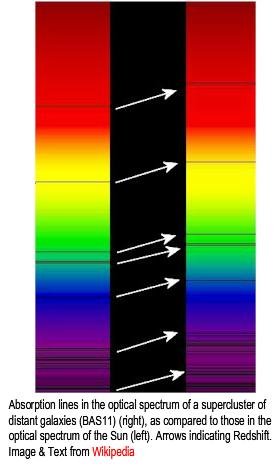
The wavelengths at which an element emits light are known. This is especially important in astronomy when studying stars — researchers examine the wavelengths of light emitted by a star. From this data, they can deduce which elements the star contains, as well as the concentration of those elements. When the observed wavelengths from a star are compared to a standard reference table, there is usually a shift. If the star is moving away, the wavelengths get longer (REDSHIFT) (see image on the right); if it is approaching, the wavelengths get shorter (BLUESHIFT). This shift is named the Doppler Effect in honor of Christian Doppler, who identified and adapted this phenomenon to physics.
Today we know that the Doppler Effect occurs between all relatively moving frames and applies across the full range of wavelengths.
Electromagnetic Spectrum
 Within this wide range of the spectrum, our eyes are sensitive
to only a small portion of the wavelengths. This range is what we call visible light.
Some wavelengths that we cannot see are used, as you know,
in communication, medicine, heating, and many other applications.
Within this wide range of the spectrum, our eyes are sensitive
to only a small portion of the wavelengths. This range is what we call visible light.
Some wavelengths that we cannot see are used, as you know,
in communication, medicine, heating, and many other applications.
The electromagnetic spectrum is extremely wide. Theoretically, wavelengths can vary from zero to infinity. The table to the side shows how electromagnetic waves are classified according to their wavelengths and frequencies.
Our eyes are sensitive to only a narrow part of this vast spectrum range — we call that part visible light. As you know, other parts of the spectrum are used in communication, medicine, heating, and various other fields.
For electromagnetic waves, the general relation between wavelength and frequency is as follows. We will later explain why this is the case.

Figure 1 — The Doppler Effect occurs in a way very similar to the animation shown here.
In the animation, there is a roll of moving paper.
We can control the speed of the paper.
A pen oscillates up and down at a constant speed and frequency,
drawing a line on the moving paper below.
The shape of the line will vary depending on the speed of the paper.
In horizontal motion, whether the pen is stationary and the paper moves,
or the pen moves and the paper is stationary, the result is essentially the same.
Figure 2 — Doppler Effect
In this figure, we see the previous animation adapted to electromagnetic waves. Instead of a pen, there is a magnet that vibrates steadily. These vibrations are transmitted through electromagnetic waves from the field to the spaceship.
Every effect created on the field moves toward the spaceship at the speed of light, c. Here, c is the speed of the electromagnetic wave relative to the field. The motion and direction of the spaceship do not change this speed. However, the speed and direction of the spaceship do change the shape of the line drawn by the magnet (i.e., the electromagnetic waves are altered). This is because the spaceship carries its field along with itself. As we can see, the change in shape manifests as a change in wavelength. If the spaceship is in motion, it will detect a wavelength that differs from normal — in other words, it will observe a Doppler shift. Let us note that the Doppler Effect occurs during the emission of electromagnetic waves from the source (magnet).
As seen, when the spaceship moves toward the source, wavelengths shorten (BLUESHIFT), and when it moves away from the source, wavelengths stretch (REDSHIFT).
The values in the animation are in pixels per second. For realism, the speed of light is set to 299.792458 pixels/sec. To interpret the animation correctly, after setting the velocity, wait until all wavelengths appear equal.
Figure 3 — Doppler Effect
Here, we see a more advanced version of the previous animation, now using light. In terms of the formation of the Doppler Effect, it makes no difference whether the observer moves and the light source remains still, or the source moves and the observer stays stationary — the result is the same. Fundamentally, it should not matter which one is moving.
Although light (photons) is an electromagnetic wave, each photon is an independent packet of energy. Therefore, the most realistic representation in the animation is the fourth option. However, since we can classify electromagnetic waves by their frequencies, it is also possible to interpret them using options 1, 2, and 3.
If we focus on the fourth option, we can see another important result of the Doppler Effect: the power of the incoming light (its luminous intensity) increases or decreases. When the observer approaches the source, the number of photons received per unit time increases. When the observer moves away, the number of photons received per unit time decreases.
The Doppler Effect also has a second influence on photons: when the observer moves toward the source, the incoming photons are more energetic; when moving away, the opposite occurs.
Here we see the relationship between wavelength and frequency based on the (c+v)(c−v) mathematics. The changes in wavelength and frequency are directly dependent on this mathematical formulation.
Figure 5 — Relationship Between Wavelength and Frequency
If we look at the figure, we can see that a wave with a length equal to one wavelength travels across the field at the speed of light, c, in time t. That is, λ = c × t. Therefore, the time t is also t = λ / c. This t is also the period (T) of an electromagnetic wave of length λ. In other words, t = T.
There is also the well-known equation between period and frequency: T = 1/f. Since t = T, we can write t = 1/f. Frequency is the number of repetitions per unit time. If we substitute 1/f into λ = c × t, we get: λ = c / f, or f = c / λ.
At the bottom of this page, we summarize the Doppler Effect equations, which we derived on the previous page.
Figure 6 — Direct Relationship Between the Doppler Effect and Relativity Effects, and the Erim Equations
Relativity effects such as length contraction, time dilation, and perception speed changes never occur independently. If time dilation is observed, then the other effects are also present simultaneously. Detecting a Doppler shift in an observation indicates that relativity effects are at play. This is because the cause of the Doppler Effect is the same as the cause of relativity effects — and they occur together, at the same moment.
We’ve already seen how relativity effects are formulated in the sections on length deformation, time dilation, and simultaneity. Because the Doppler Effect uses the same equations, the connection is easily made. If we detect a redshift or blueshift in an observation, we can use the amount of wavelength change to calculate the degree of the accompanying relativity effects.
This chart is the result of my realization of the connection between the Doppler Effect and relativity effects. I wanted to give the table a name, and I named it after my surname: "ERIM".
Using the buttons above the chart, you can access the related pages for each section and directly explore their relationships.
Maximum and Minimum Limits for Wavelength and Frequency
The Doppler Effect occurs within specific limits. These limits are defined by the maximum relative speed between reference frames. As far as we know, no material object can exceed the speed of light, c. While it is possible to imagine alternative hypotheses, we will not go into them here.
If we take c as the maximum speed for material objects, then two reference frames can at most approach or recede from each other at that speed. Therefore, in (c+v)(c−v) mathematics, the value v — which represents the relative speed between frames — ranges between +c and −c (*). If we plug +c and −c into the equations, we can determine the maximum and minimum limits.
Accordingly, the variation ranges for an electromagnetic wave are:
For Wavelength:
0 ≤ λ ≤ 2λ
For Frequency:
ƒ/2 ≤ ƒ ≤ ∞
You’ve likely already seen and felt these frequency and wavelength limits through the animations in this section. These same limits also define the boundaries for relativity effects. For example, the tick-tock interval of a clock can, at most, double.
(*) See the Alice Equation section.
In motion involving force, since velocity changes over time, as expected, the Doppler Effect either increases or decreases with time. We can see this behavior clearly in the graphs.
Now we’ve arrived at a truly interesting point — GENERAL RELATIVITY. Adding the effect of force to (c+v)(c−v) mathematics in order to generalize it, is what we mean by General Relativity. The chart on this page is a very clear example that shows us what General Relativity is. From now on, General Relativity becomes this simple.
We will continue with the section on the Alice Equation.