Banner
Alice Law Version 7
Alice Law and Mathematics
Han Erim
May 7, 2012
Copyright © 2012 Han Erim, All Rights Reserved.

ALICE LAW AND ALICE MATHEMATICS
Even as an amateur, I enjoy programming. I once wanted to develop a file compression (zip) program.
I believed it was possible to create interesting algorithms using number bases.
Perhaps I could find a good algorithm and develop a good compression program.
So I began working on number bases. How could I have known this path would lead me to the Alice Law?
LEFT DIRECTION IN MATHEMATICS
It is possible to interpret the number base system in two different ways.
The first method is the classical number base system.
In the classical method, the largest number is considered infinite.
I named the mathematics based on this assumption the LEFT DIRECTION of MATHEMATICS.
We can interpret the classical number base system geometrically as follows:
let's say we have a rod that represents the number 1.
The length of this rod does not change depending on the base.
To obtain any number, we place that many rods end to end.
In the left direction, the following equalities exist between numbers in different bases mathematically:
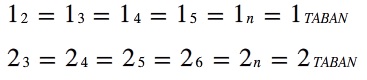
RIGHT DIRECTION IN MATHEMATICS
It is also possible to construct a number base system in which the largest number is equal to 1.
I called the mathematics based on this assumption the RIGHT DIRECTION of MATHEMATICS.
The geometric interpretation of the RIGHT DIRECTION is as follows:
for each base, the rod representing the number 1 has a different length.
If we connect rods of a particular base end to end, when the rods reach their first repeat count (which is 10),
an equality is established among all bases.
As I mentioned earlier, I was trying to create an algorithm for a compression program.
This is the algorithm I found. I believe the right direction number base system is my own original idea.
If someone else thought of it before, I sincerely congratulate them.
In right direction mathematics, the equalities are formed as follows:
RIGHT DIRECTION AND "LENGTH 1"
I developed a set of preliminary rules for the mathematics of the right direction.
These rules are important at least for the context of this study.
In the Right Direction, numbers are, as a rule, expressed in fractional form.
This form is the division of a number by its own base.
As a result, every number’s numerical value falls within the range of 0 to 1.
This 0–1 range is called "Length 1". The number 1 is the largest number.
Despite its fractional appearance, the Right Direction is a form of integer mathematics.
Every element belonging to a number base is an integer.

RIGHT DIRECTION AND FREQUENCIES
The numbers in the right direction table can be carried onto Length 1.
Once positioned on Length 1, these numbers are called FREQUENCIES.
Each number is placed on Length 1 according to its numerical value.
Every point on Length 1 represents a different frequency value.
Since number bases are infinite, Length 1 can carry an infinite number of frequency values.
Numbers from number bases that share the same frequency value on Length 1 are considered equal.
Therefore, if multiple frequencies have the same numerical value, the duplicates are removed
and only a single frequency is retained for that value.
flash5
LENGTH 1 AND FIELDS
The Mathematics of the Right Direction is important for physics,
because the frequencies on Length 1 are in perfect harmony with field mathematics in physics.
There is the following equality between frequency, mass, and distance:
d = f × m
distance = frequency × mass
The existence of this equation makes it possible to express physical field laws
(Newton’s law of gravity and Coulomb’s inverse-square law for electric charge)
in terms of frequencies.
In fact, no matter what the nature of the study is, if values are to be represented
in the 0–1 range, frequencies can be used. For this reason, Length 1 is a valuable
and useful concept.
flash6
FREQUENCIES AND FIELD MATHEMATICS
You can see here how Length 1 and frequencies align with field mathematics.
By selecting a sample mass value, you can generate field values
and related graphs for that mass.
Enter a number into the box at the top left for the mass value and click the Create button.
The red arrows between the buttons will guide you.
What is the Alice Law really?
The Alice Law is a field law. It assumes that all objects possess
a special space of their own — in other words, a field — and expresses an object's field
using Length 1 and frequencies. That’s how simple the Alice Law is in essence.
It also has a very special physical postulate, which I’ve presented
in a separate section in the program.
Fields are, of course, very intriguing structures.
In truth, we know almost nothing about what they actually are,
but we can observe and measure their effects.
The Alice Law is a gateway to this unknown world, a path leading into it.
We might think of it like this: if, by any chance, we can explain
how frequencies are formed, we may also be able to understand and explain
what fields are. The Alice Law actually offers some clues —
but let’s not go into those details here.
One thing is certain though:
in the future, fields will become the greatest research subject in physics.
THE POWER OF THE ALICE LAW
Around the year 1998, I began focusing my studies in this direction
after realizing the strong connection between frequencies and field mathematics.
I chose a mathematical model like this:
Consider an object with mass m as a number system with base m.
Then, include in this number system all other number systems with bases smaller than m.
In this case, we obtain a unique frequency table for mass m.
(This is exactly what I was doing, as shown two pages earlier.)
Working on this model for a long time led me to the idea
that every object might have its own special space.
From there, I arrived at the concept of a FIELD.
I named this path the Alice Law.
Reaching the field concept led me to the idea
that light might travel within these special spaces — fields.
At that point, I developed the mathematics of (c+v)(c−v) for describing light's behavior.
Of course, everything up to that point was purely theoretical.
I wondered: “Could there be results confirming the (c+v)(c−v) mathematics?”
When I researched this on the internet, I found information that seemed to support it.
That gave me the courage and motivation to continue.
The work I did to adapt the (c+v)(c−v) mathematics to the theory of relativity
ultimately led me to rewrite the theory from scratch.
This journey has been extraordinary for me at every stage.
link