Alice Equation
Han Erim
May 7, 2012

ALICE EQUATION
In the mathematics of (c+v)(c-v), what is the meaning of the value v?
In the animations we see in the sections of the program, the movements of the frames relative to each other are considered along the X-axis for simplicity. For this reason, a situation has arisen where the v value in the mathematics of (c+v)(c-v) appears to indicate the velocity difference between the frames. (Indeed, in some parts of the program, I have stated this myself). However, this is not entirely accurate.
In the mathematics of (c+v)(c-v), the value v indicates the deviation amount from the speed of light. The value v does not indicate the velocity difference between frames.
The movements of the frames relative to each other can be in any direction and at any speed. In such cases, we will see here how to calculate the v value. The mathematical equation used in the calculation method is extremely important for both Electromagnetic Theory and the Theory of Relativity. Since the equation is so important, I wanted to give it a name and I named it the ALICE EQUATION.
Figure 1, WORKING PAGE
On this page, we see the motion graph we will use to calculate the v value in the mathematics of (c+v)(c-v). A flashlight sends a short beam of light to the observer.
In the graph, the points O,O',P,P' are movable points. These points help us to set the direction and speed of motion of the frames. By changing the positions of these points, you can set the graph for any situation and analyze the mathematics of (c+v)(c-v).
The graph works on the following principle:
The light starting from Frame A reaches Frame B.
During the time until arrival;
Frame A covers the distance OO'
Frame B covers the distance PP'
By moving the slider, we can see all the stages of the event as it occurs.
When you change the positions of the points O,O',P,P', the graph automatically adapts to the new situation.
BLUE ARROWS indicate the distances traveled by the frames.
THE YELLOW ARROW represents the magnitude of the v value in the mathematics of (c+v)(c-v). The purpose of this graph is to show how it forms.
On the following pages, I will show a few details related to the graph that I consider important.
Figure 2, POSITION OF THE GHOST
The animation here is set to the moment the light arrives.
If you changed it, please move the slider to the far right.
Using a ruler that symbolizes the observer’s field,
we can easily find where the observer will see the ghost.
According to the observer’s reference system,
wherever the signal enters the field (Point G),
the observer sees the ghost at that point.
We can also determine the position of the ghost
using the resultant vector of the OP and PP' lines.
THE SPEED OF LIGHT IS INDEPENDENT OF THE SOURCE FROM WHICH IT IS EMITTED.
Drag point O'—the arrival point of the flashlight—
to change the direction and magnitude of the blue arrow for the flashlight.
You will see that the direction and speed of the flashlight
have no effect on the position of the ghost.
Electromagnetic waves move independently of the speed and direction
of the source from which they are emitted.
This topic is discussed in detail in the EXPERIMENT section of the program.
Figure 3, PATH OF LIGHT
The path of light is different for both reference systems.
According to its own reference system, Frame A observes the light traveling toward point Q.
According to its own reference system, Frame B sees the light
coming from point G. Keep in mind that the light is traveling
within the area of Frame B.
Figure 4, ALICE EQUATION AND CALCULATION OF THE V VALUE
Let’s keep the slider at the far left, i.e., at the starting position.
If the frames were not moving, light would travel the OP distance in a time like t. (OP = c . t)
We draw a circle centered at point O' with a radius equal to the OP distance.
We draw a line connecting points O' and P', and extend it to intersect the circle (point S).
The distance O'S will be equal to the distance OP. (OP = O'S)
Now, let's move the slider all the way to the right.
We know the GP' distance is equal to OP. Therefore,
light will travel the GP' distance in the same time t. (GP' = OP = c . t)
For this reason, in measurements made from the position of Frame B (the target of light arrival),
the speed of light is always found to be "c".
On the other hand, the situation is different for Frame A:
In the same time t, light travels the O'P' distance.
We see in the figure that the O'P' distance is shorter than the OP distance.
(OP = O'S and OP > O'P').
Since light travels the O'P' distance in the same time t according to Frame A;
According to Frame A, the speed of light moving toward Frame B is c' = O'P'/t.
(Speaking for the graph shown here, c > c')
We can write (c' = c - v) for the speed c'. Thus, the v value becomes the
amount of change in the speed of light. From here, we can write the two equations below:
O'P' = c'. t = (c - v).t
P'S = v.t
The P'S distance shown by the yellow arrow gives us the v value we are looking for.
P'S = v . t
Now we can write the Alice Equation.
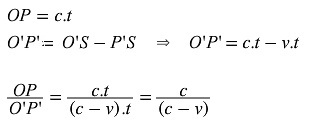
Here, for the graph, we obtained a result in the denominator on the right side as (c - v).
When we set the graph for different movement directions, we can also get
a result in the form of (c + v) for the denominator on the right side of the equation.

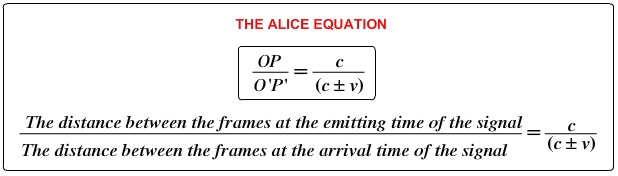
If the direction of the yellow arrow is inward toward the circle, the v value is negative (-)
If the direction of the yellow arrow is outward from the circle, the v value is positive (+).
The Math button on the page provides a summary of this equation.
Finally, let's also see the relation between the movement speeds of the frames and the OP distance.
If we denote the speeds of the frames as V1 and V2;
the distances covered by the frames during time t:
OO' = V1.t
PP' = V2.t
Since OP = c.t, the following equations are obtained for the speed values
V1 and V2:
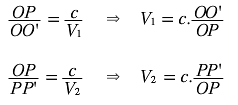 Alice Equation
The Alice Equation we see here plays a fundamental role in the main topics of relativity:
Time Dilation, Length Contraction, Simultaneity, and the Doppler Effect.
All relativistic effects occur in proportion to the magnitude of the v value we see forming here.
The graph we used also shows how electromagnetic interaction occurs
between frames moving relative to each other. Therefore,
the Alice Equation is a valid and determining equation for both
the Theory of Relativity and Electromagnetic Theory.
The v value indicates the deviation amount from the speed of light.