In Chapter 3, I discussed the Galilean Principle of Relativity in considerable detail. I explained the importance of this principle for Alice Law and emphasized that it should also encompass Electromagnetic Theory. I described the similarities and differences between the way Alice Law treats the Galilean Principle of Relativity and Einstein’s Principle of Relativity.
Here I will explain the second part of Alice Theory. In this explanation, I will use the Galilean Principle of Relativity in its extended form, encompassing electromagnetic theory. I will show you how important this principle is and why extending it to electromagnetic theory is vital for logical deductions. I think that as the subject progresses, you will be surprised by what you see; but in the end, your reason will prevail and you will thoroughly grasp the Galilean Principle of Relativity.
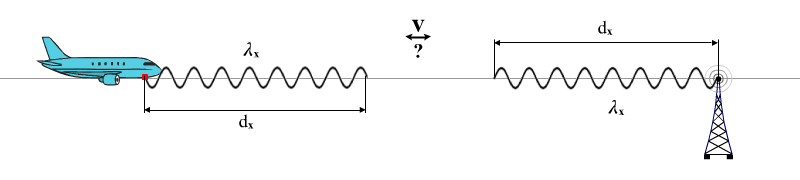
We will now examine Figure 4.1 below on the basis of the Galilean Principle of Relativity.
Figure 4.1 – The airplane and the tower transmit signals to each other.
Let us first assess the situation depicted in the figure:
We are observing the event in the figure from the ground reference frame.
The tower and the airplane are two objects moving at speed v relative to each other.
Identical signal-generating devices are used in the tower and the airplane.
They began transmitting signals to each other at the same time.
The figure represents a moment when the signals have not yet reached their targets.
Now let us examine the event in the figure from the standpoint of the Galilean Principle of Relativity:
In terms of the laws of physics, it does not matter whether the tower or the airplane is at rest or in motion. The laws of physics apply in the same way to both.
Our observing the event from the ground reference frame has no effect whatsoever on the event occurring between the tower and the airplane.
Because the airplane and the tower use identical devices and transmit at the same frequency, the signals will be emitted with identical wavelengths and identical frequencies.
If the wavelength of the signal traveling from the airplane toward the tower is λx, the wavelength of the signal traveling from the tower toward the airplane must likewise be λx.
When the airplane measures the wavelength and frequency values of the signals reaching it and compares them with the signal values measured by the tower, it will find that equal results are obtained. The converse is also true.
Because the airplane and the tower began transmitting at the same time, the signals must reach their targets at the same time.
In addition, I would like to share something I learned from the animation work I carried out concerning Alice Law.
When the waveforms created in the sky by the signals transmitted by the towers and the airplane are compared, they are seen to be mirror images of one another and identical in form. For example, if we rotate the waveform created by the signals transmitted from the towers by 180 degrees in the horizontal plane and place it over the waveform created by the signals transmitted from the airplane, we see that there is no difference between them in terms of form.
In practice, because electromagnetic waves are invisible, it is not possible to observe the existence of this situation. However, I can illustrate it as follows. Let us assume that the signals transmitted by the tower and the airplane are communication signals. Let them begin sending the same message to each other at the same time. At any given moment, whichever part of the message transmitted by the airplane the tower is receiving, the airplane will be receiving the same part of the message transmitted by the tower.
In the event given as an example above, I have applied the Galilean Principle of Relativity to Electromagnetic Theory. In this way, I believe I have clearly demonstrated what the Galilean Principle of Relativity means for Alice Law. Alice Law frequently uses the Galilean Principle of Relativity in all its theoretical deductions and draws its strength from it. The Galilean Principle of Relativity is of vital importance to Alice Law.
We may now continue with our subject.
I am making a change to the current event scenario. Namely, let the towers on the sides transmit signals to the airplane in the middle. Let us see what result we obtain in this case.
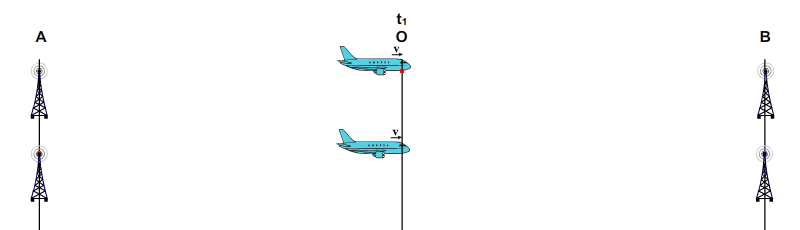
Here, too, I similarly show two figures one beneath the other. In the upper figure, the airplane transmits signals to the towers at positions A and B. In the lower figure, the towers at positions A and B transmit signals to the airplane in the middle. The distances AO and OB are equal to each other, and the speeds of the airplanes are equal. The event begins when the airplanes are at position O.
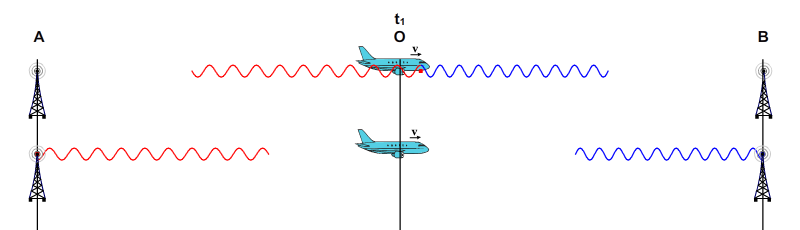
Figure 4.2 – Beginning of the event. The airplanes are passing through position O at speed “v.” Signal transmission begins at this moment.Figure 4.3 – The airplanes continue along their routes. In the upper figure, the signals transmitted from the airplane are traveling toward the towers on the sides. In the lower figure, the signals transmitted from the side towers are traveling toward the airplane.
According to the Galilean Principle of Relativity, the signals the airplane transmits to tower A and the signals tower A transmits to the airplane must be identical. Similarly, the signals the airplane transmits to tower B and the signals tower B transmits to the airplane must be identical to each other. In Figure 4.3 above, the signals are traveling toward their targets in accordance with this identity.
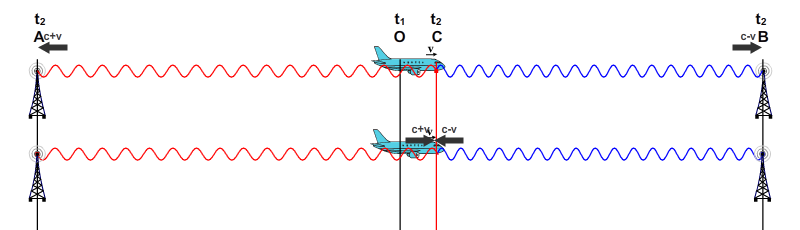
Figure 4.4 – The signals reach their targets at the same time.
The moment all hell breaks loose: Figure 4.4.
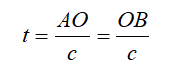
We already know that the signals in the upper figure will reach the towers at the same time. This is because the signals cover the equal distances AO and OB at speed “c”:
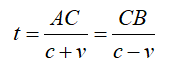
However, the Galilean Principle of Relativity in its extended form, encompassing electromagnetic theory, requires the signals transmitted from the towers to reach the airplane at the same time even though AC > CB in the lower figure. This condition can be satisfied only if the speeds of the signals transmitted from the towers differ from each other:
Here, t = t2 − t1 is the time elapsed from the moment the signals are emitted until the moment they reach their targets.
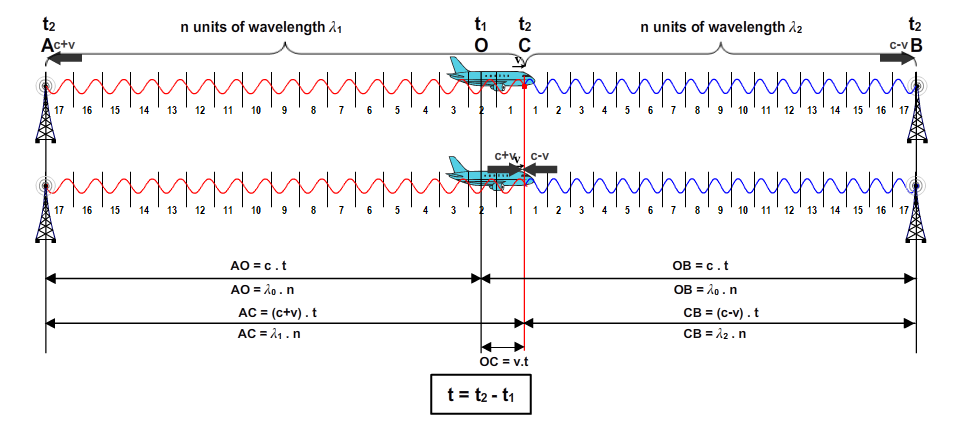
Now let us examine in Figure 4.5 the mathematical results we can obtain from Figure 4.4.
Figure 4.5 – Comparison of the signals at the moment of arrival and derivation of the mathematical data. In the upper figure, the signals transmitted by the airplane have reached towers A and B on the sides. In the lower figure, the signals transmitted by towers A and B have reached the airplane. According to the Galilean Principle of Relativity in its extended form, encompassing electromagnetic theory, the corresponding mathematical quantities obtained from the upper and lower events must be equal to each other. The figure shows that these equalities are satisfied.
Now let us examine the results that arise in Figure 4.5.
In Part One of Introduction to Alice Theory, we established that, relative to the airplane’s reference frame, the speeds of the signals it transmits to the towers are “c+v” and “c−v” (Figure 2.5). Here I will write this in somewhat greater detail. Let us first consider the event in the upper figure.
Tower A is moving away from the airplane. Relative to the airplane’s reference frame, the speed of the signal the airplane transmits to the tower at position A is “c+v.”
Tower B is approaching the airplane. Relative to the airplane’s reference frame, the speed of the signal the airplane transmits to the tower at position B is “c−v.”
Relative to the towers’ reference frames, the speed of the signals reaching them is “c.”
Because the towers are stationary relative to the ground reference frame, the speed of the signals in both directions is “c” relative to the ground reference frame.
Now we have reached the great moment when everything is turned upside down and Alice reduces everything in physics to ashes.
Using the Galilean Principle of Relativity, let us examine in detail the event shown in the lower parts of the figures, namely the situation in which the towers transmit signals to the airplane. According to the Galilean Principle of Relativity in its extended form, encompassing electromagnetic theory, exchanging the positions of the source and the target must not change the physical results of the event.
According to the Galilean Principle of Relativity, the towers and the airplane are moving relative to one another. There is no absolute answer as to which one is in motion. The laws of physics must apply in the same way to the towers and the airplane.
In the upper figure, tower A and the airplane are moving away from each other, and the speed of the signal transmitted by the airplane is “c+v” relative to the airplane’s reference frame. Therefore, in the lower figure, the speed of the signal tower A transmits to the airplane must be “c+v” relative to its own reference frame.
In the upper figure, tower B and the airplane are approaching each other, and the speed of the signal transmitted by the airplane is “c−v” relative to the airplane’s reference frame. Therefore, in the lower figure, the speed of the signal tower B transmits to the airplane must be “c−v” relative to its own reference frame.
In the upper figure, the wavelength of the signal the airplane transmits to tower A is λ1. Therefore, in the lower figure, the wavelength of the signal tower A transmits to the airplane must be λ1.
Since the wavelength of the signal the airplane transmits to tower B is λ2 in the upper figure, the wavelength of the signal tower B transmits to the airplane must be λ2 in the lower figure.
Since the change in the signals transmitted by the airplane occurs at the moment of emission, the change in the wavelengths of the signals transmitted from the towers will likewise occur at the moment of emission.
The waveforms created in the sky by the signals in the upper and lower figures must be identical.
At the moment when the signals transmitted by the airplane reach the towers in the upper figure, the signals transmitted by the towers must have reached the airplane in the lower figure.
I would like to include one more detail here. Relative to the ground reference frame, the speed of the signals traveling toward the towers in the upper figure is “c” in both directions, whereas the speeds of the signals traveling toward the airplane in the lower figure are “c+v” and “c−v.” This is because the signals travel at speed “c” relative to their destination, taking the destination’s reference frame as their basis. In the lower figure, relative to the airplane’s own reference frame, the speed of the signals coming toward it from the towers is “c” in both directions.
Which Geometry Does Nature Use?
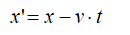
As you can see, the logical deductions of Alice Law are based to a great extent on the Galilean Principle of Relativity in its extended form, encompassing Electromagnetic Theory. Within this principle, the relations between space and time are expressed through Galilean transformations. In Galilean transformations, time is common to all reference frames; the positions of objects, the distances between them, and other geometrical relations are determined according to the rules of classical geometry. In more technical and precise terms, the rules of Euclidean geometry apply to the Galilean Principle of Relativity.
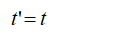
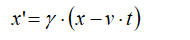
Structure of Galilean transformations
(Position)
(Time)
For this reason, a common time value can be used when examining the appearance of the same event from different reference frames. The positions of objects, the distances they travel, and the distances between them can be drawn according to the rules of ordinary geometry, and the mathematical data obtained from these figures can be used directly.
In the figures used in Chapter 2 and Chapter 4, positions, distances, directions of motion, and elapsed times have been expressed in accordance with the rules of Galilean transformations and ordinary geometry. Therefore, the information obtained from the figures gives the mathematical results of this theoretical structure. Alice Theory maintains that this structure precisely reflects the real physical relations in nature.
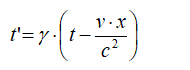
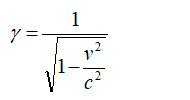
In Einstein’s Special Theory of Relativity, however, the relations between space and time are expressed not through Galilean transformations but through Lorentz transformations:
Structure of Lorentz transformations
(Position)
(Time)
(Lorentz factor)
In Lorentz transformations, time is not common to all reference frames. Simultaneity, length, and elapsed time depend on the observer’s reference frame. Relativistic relations can be represented geometrically using Minkowski spacetime diagrams based on Lorentz transformations. In these diagrams, however, time is also part of the geometrical structure, and the space and time axes of different reference frames differ from one another. Therefore, these representations differ fundamentally from the figures based on common time and ordinary geometry that I use here.
The principal distinction between the two theories is not whether the Galilean Principle of Relativity is applied to electromagnetic theory. Einstein’s Principle of Relativity also encompasses electromagnetic laws. The real distinction arises in how the speed of light is interpreted. The idea that the speed of light is c relative to all reference frames leads to the Special Theory of Relativity, whereas the idea that the speed of light is “c” relative to its destination leads to Alice Theory. These two different ideas produce different mathematical results and ultimately require different spacetime structures to be defined for the two theories. While the Special Theory of Relativity explains nature through a spacetime structure established according to Lorentz transformations, Alice Theory is based on the extended Galilean Principle of Relativity, Galilean transformations, and common time.
I would like to open a parenthesis here and address why the Theory of Relativity became the dominant theory. Although the Special Theory of Relativity was published in 1905, discussions about testing the theory experimentally and interpreting its results continued in later years. I was born in 1959, and I remember from my childhood that the decay of high-speed muons taking longer than expected was described as confirmation of the Theory of Relativity. Indeed, the Frisch–Smith experiment of 1963 and subsequent muon experiments have been accepted among the important experimental evidence for relativistic time dilation. In other words, the theory emerged in 1905; its acceptance, experimental testing, teaching, and rise to dominance in physical thought were a separate process that unfolded over decades. In addition, treating the speed of light as an insurmountable theoretical upper limit caused this process to develop in favor of the Theory of Relativity. It was not Albert Einstein, who wrote the theory, who made the Theory of Relativity one of the dominant theories of physics; it was the physicists who embraced the theory and placed it at the foundation of physics. The great political tensions and two world wars of those years, followed by work on the atomic bomb and efforts to advance high-energy physics rapidly, influenced the determination of the scientific world’s priorities. I suppose that, because of these factors, not enough different ideas could be produced and not enough discussion could take place under the conditions of those years.
Now I ask you: Are the ideas I have presented in Chapter 2 and Chapter 4 exceedingly difficult ideas to produce? Why were these possibilities not seriously considered and tested experimentally before? Should these alternatives not also have been investigated in those years? Or do you, too, think that nature does not use “c+v” and “c−v” mathematics and that speed “c” is an insurmountable limit? If your answer is “yes,” then you are trying to fit nature within the limits of your own mind. Do not do this. We cannot assume that nature is obliged to act only within the patterns of thought to which we are accustomed. We must not forget that nature’s creativity lies far, far beyond the limits of human thought. A result that seems surprising or unusual to us may be exceedingly simple and ordinary from nature’s perspective. The fact that an idea appears contrary to an established theory does not show that it is wrong. Clear logical deductions and repeatable experiments will show whether it is right or wrong.
Unfortunately, I must begin by saying this. The assumptions of the Theory of Relativity concerning space and time have become so firmly established in physical thought that today many physical events are interpreted using concepts required by Lorentz transformations without even being considered on the basis of ordinary geometry and common time. Thus, even when a direct and simple explanation of physical reality is possible, minds are compelled to think within abstract structures such as length contraction, time dilation, and the relativity of simultaneity. If we were to assume for a moment that Alice Law is correct, would you not then find yourself a person imprisoned within the Theory of Relativity, whose thinking has become ill?
Here I am criticizing not individuals but the approach that rejects an alternative idea without first examining it. I liken an established theory’s setting the limits of thought and preventing other possibilities from being evaluated to an intellectual illness that has spread throughout the world of physics. In this respect, there is virtually a pandemic, and a very large proportion of physicists have been affected, to a greater or lesser degree, by this established way of thinking.
Alice is extending a helping hand to you from here. Alice wants you to read her, examine her logical deductions, and conduct the experiments she predicts. Do not cause her to withdraw the hand she has extended.
I close the parenthesis here.
It is certain that whether the Galilean Principle of Relativity encompasses Electromagnetic Theory can be tested experimentally. Therefore, if Alice Theory and the Special Theory of Relativity predict different results in specific experimental setups, experiments can determine which approach correctly explains nature.
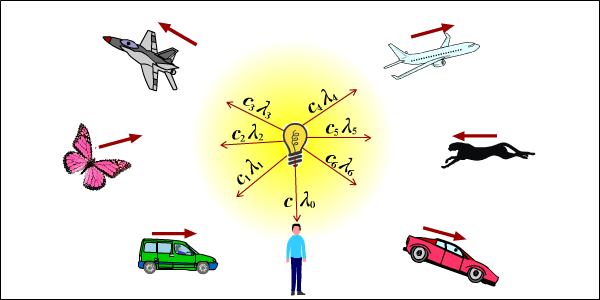
Figure 4.6 – An image taken from my book “Alice Law and the Transition to (c+v) (c−v) Mathematics in Electromagnetic Theory (Alice Law Version 8),” published in 2017. The image depicts light from the same light source traveling toward surrounding moving objects at different speeds and possessing different wavelengths. The image has been updated by adding the wavelengths.
The image above summarizes the fundamental structure of radiation from the perspective of Alice Theory. Now I ask you: Why do you not know such a simple truth?
Alice Law’s restoration of ordinary geometry and mathematics to dominance in physics will be its greatest gift to physics.

 In Chapter 3, I discussed the Galilean Principle of Relativity in considerable detail. I explained the importance of this principle for Alice Law and emphasized that it should also encompass Electromagnetic Theory. I described the similarities and differences between the way Alice Law treats the Galilean Principle of Relativity and Einstein’s Principle of Relativity.